
Published September 3, 2026
A manufacturing skills matrix should answer a practical question before the next shift begins: Do we have enough qualified people to run every critical task safely, correctly and without avoidable delay? Many factories cannot answer that question with confidence. Their learning management system shows completed courses, supervisors keep informal knowledge in their heads, and spreadsheets record certifications—but none of those sources necessarily shows who can perform a particular task independently today.
That gap matters more as manufacturing roles change. The World Economic Forum estimates that 39% of workers’ core skills will change by 2030. Its 2025 survey also found that 63% of employers consider skills gaps a major barrier to business transformation and 85% plan to prioritize upskilling. Meanwhile, the new 2026 Manufacturing USA Occupation and Competency Framework gives manufacturers a common language for the future-facing knowledge, skills and abilities their workforces need.
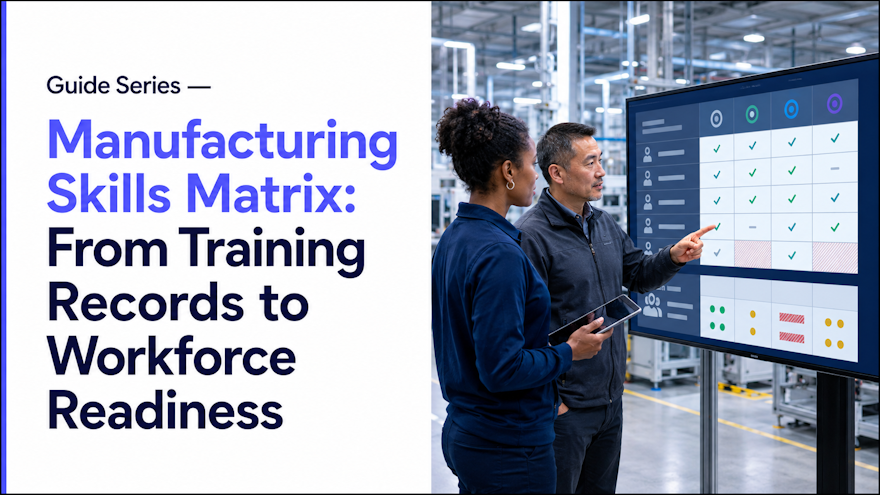
The opportunity is not to build a larger spreadsheet. It is to connect roles, operational tasks, approved knowledge, learning, observed performance and qualification evidence. Done well, a skills matrix becomes a live workforce-readiness system: one that guides cross-training, exposes single-person dependencies and tells managers where capability must be developed next.
Use this guide to move from course-completion records to evidence of executable capability:
- What is a manufacturing skills matrix?
- Why training completion is not qualification
- How to build the matrix step by step
- Define observable proficiency levels
- Connect competencies to approved knowledge
- Keep the matrix current
- Measure workforce readiness
- Frequently asked questions
What is a manufacturing skills matrix?
A manufacturing skills matrix is a structured view of the skills required for specific roles or production tasks and the current proficiency of the people expected to perform them. Employees or roles usually appear on one axis; machines, processes, quality checks or workstations appear on the other. Each intersection shows a defined capability level supported by evidence.
The most useful matrices work at the level where production decisions are made. “Packaging” is too broad. “Set up the labeler for Product Family A,” “perform the in-process weight check” and “respond to a rejected vision-system reading” are observable tasks. A supervisor can assign them, an operator can demonstrate them, and Quality can verify the relevant evidence.
This task-level approach aligns with the direction of the 2026 Manufacturing USA framework. The associated NIST analysis connects 132 advanced-manufacturing occupations to 235 knowledge, skill and ability requirements, grouped into 13 competencies and 68 subcompetencies. The message for employers is straightforward: job titles alone are no longer precise enough for workforce planning.
A skills matrix can support several decisions:
- Which operators can work independently at each station?
- Where does a shift rely on only one qualified person?
- Who can coach or assess another employee?
- Which qualifications are approaching expiry?
- Which employees are ready for cross-training?
- Which SOP revision creates a new capability gap?
Training completion is not the same as qualification
A completion record proves that an activity occurred. It might show that an employee opened a course, passed a quiz or signed that they read a procedure. Qualification answers a different question: can that person perform the assigned operation to the required standard under real working conditions?
That distinction is especially important in Life Sciences. 21 CFR 211.25 requires personnel engaged in drug manufacturing to have the education, training and experience needed to perform their assigned functions. FDA’s 2026 Compliance Program 7346.832M likewise tells investigators to evaluate whether personnel are trained and qualified. EU GMP Chapter 2 requires appropriate initial and continuing training and says its practical effectiveness should be periodically assessed.
For a critical task, a defensible evidence chain might look like this:
Approved procedure → role requirement → role-based learning → guided practice → observed demonstration → qualification decision → periodic review.
The skills matrix is the layer that makes this chain visible. It should not replace the LMS, QMS or training record. Instead, it should bring their evidence together around operational capability.
How to build a manufacturing skills matrix step by step
1. Start with operational scope
Choose one production area, line or process family. Beginning with the entire company often produces a matrix so large that nobody maintains it. A focused pilot—such as aseptic filling setup, packaging changeover or preventive maintenance—lets the team agree on definitions and test the workflow.
2. List roles before people
Define what the role requires independently of the person currently holding it. Include operators, technicians, line leaders, quality reviewers and qualified trainers where relevant. Role-first design makes expectations reusable for onboarding, transfers and succession planning.
3. Break each role into observable tasks
Use the approved process, SOPs, work instructions, deviation history and supervisor input to identify the tasks that affect safety, product quality, compliance, output or recovery from abnormal conditions. Write each skill as an action: “verify line clearance,” not “line-clearance knowledge.”
4. Add risk and criticality
Not every empty cell deserves the same urgency. Classify tasks according to consequence and operational need. A capability required for a critical control point, scarce maintenance intervention or frequent deviation should receive more attention than an optional secondary skill.
5. Define evidence before assigning scores
Decide what proves each level: completed learning, supervised repetitions, an observation checklist, a practical assessment, a certification, recent task execution or approval by a qualified evaluator. Without common evidence rules, the matrix becomes a collection of opinions.
6. Establish the baseline
Populate current status using existing records, then validate high-risk entries with supervisors and employees. Avoid automatically translating “course completed” into “qualified.” Where evidence is missing or outdated, mark the status as unverified rather than guessing.
7. Prioritize cross-training
Look for uncovered tasks, single qualified operators, weak night-shift coverage, expiring qualifications and experts approaching transfer or retirement. The result should be a short capability-development plan, not merely a colorful chart.
Define proficiency levels people can observe
A simple scale is easier to govern than a ten-level model. The labels can vary, but every level needs an observable definition:
| Level | Meaning | Typical evidence |
|---|---|---|
| 0 — Not trained | Not authorized to perform the task | No current learning or practice record |
| 1 — Aware | Understands purpose, risks and basic sequence | Assigned learning completed; knowledge check |
| 2 — Assisted | Performs with supervision or prompts | Guided practice and coaching record |
| 3 — Qualified | Performs independently to the approved standard | Observed demonstration against defined criteria |
| 4 — Trainer | Can execute, explain, troubleshoot and coach | Evaluator approval plus current task expertise |
Keep knowledge, authorization and demonstrated performance separate. Someone may understand a task but lack authorization to perform it independently. Another person may have qualified years ago but no longer meet a recency requirement. The matrix should make those differences visible.
Connect every competency to approved knowledge and practice
A static matrix identifies gaps but does not close them. Each required capability should connect directly to the approved resources that help an employee learn and execute it: the source SOP, a concise role-based module, an expert demonstration, a visual workflow, a practice checklist and the assessment criteria.
This is where knowledge execution becomes more useful than document storage alone. The employee should not need to search through a long procedure to find the exact instruction for the task at hand. Guidance should be available in the flow of work, while the organization retains ownership, version control and review.
When a procedure is lengthy, teams can use an SOP-to-training workflow to create different assets from the same controlled source: training for initial understanding, visual steps for execution, questions for knowledge checks and concise job aids for point-of-work support. The approved procedure remains authoritative; the delivery format becomes role- and task-specific.
For repeatable coaching, connect the matrix with Training Within Industry. Its Job Instruction approach gives supervisors a consistent method for preparing workers, presenting a task, observing practice and following up. For program design and rollout, Speach’s guide to scaling on-the-job training in manufacturing provides a complementary framework.
Keep the skills matrix current
The most dangerous matrix is one that appears precise but reflects last year’s reality. Capability data changes when people move roles, procedures change, equipment is upgraded, certifications expire or a skill is not practiced for a long period.
Assign an owner and define update triggers from the beginning. Useful triggers include:
- A new hire, transfer, promotion or extended absence
- A revised SOP or work instruction
- New equipment, automation or production technology
- A deviation, safety event or recurring quality defect
- An assessment result or supervisor observation
- Qualification, license or certification expiry
- A defined period without performing a critical task
When an SOP changes, perform a role and task impact assessment. Identify what changed, which competencies are affected, who currently holds those competencies and whether the change requires awareness, targeted delta training, supervised practice or requalification. This prevents a minor document revision from generating unnecessary retraining while ensuring a material change receives proper attention.
Measure workforce readiness—not just learning activity
Course completions and quiz scores remain useful, but they are leading indicators. A skills matrix allows operations and training teams to monitor outcomes closer to execution:
- Critical-task coverage: percentage of critical tasks with at least two currently qualified people per required shift
- Qualification lead time: days from role assignment to independent qualification
- Capability-gap closure: priority gaps resolved during the period
- Evidence currency: percentage of qualifications supported by current evidence
- Cross-training depth: average number of qualified operators per critical station
- Execution outcomes: deviations, rework, errors or support requests associated with targeted tasks
Be careful about claiming causation. A lower deviation rate may reflect equipment, materials, staffing or process changes as well as training. Use the matrix to form and test operational hypotheses: where a capability gap is linked to an outcome, strengthen the guidance and practice, then monitor whether both proficiency evidence and performance improve.
The goal is not to turn every worker into an entry in a database. It is to give people clear expectations, relevant development opportunities and confidence that they are prepared for the work assigned to them. For managers, the benefit is equally practical: fewer surprises when demand changes, an expert is unavailable or a new process goes live.
Frequently asked questions
What is the difference between a skills matrix and a training matrix?
A training matrix usually shows which courses or learning activities are required or completed for each role. A skills matrix shows the level at which a person can perform specific work. The two should be connected, but course completion should not automatically equal task qualification.
What should be included in a manufacturing skills matrix?
Include the relevant roles or employees, observable production tasks, required proficiency, current proficiency, evidence source, assessor or approver, qualification date, expiry or review date, task criticality and links to the current approved procedure and learning resources.
How many proficiency levels should a skills matrix have?
Four or five levels are usually sufficient if each has a clear, observable definition. More levels can create false precision and inconsistent ratings. The evidence required for each level matters more than the number of levels.
How often should a manufacturing skills matrix be updated?
Update it when a person, role, procedure, technology or qualification status changes. Review critical-task coverage regularly at the operational cadence that matters—often monthly or quarterly—and verify that high-risk qualifications remain current.
Can a skills matrix support GMP compliance?
Yes, as part of a controlled training and qualification system. It can help show which roles require particular competencies and point to supporting records. It does not replace approved procedures, validated systems, training records or qualified-person decisions.
Turn the matrix into action
Begin with one operational area and five questions: What work must be performed? Which roles perform it? What does independent competence look like? What evidence proves it? What happens when the underlying knowledge changes?
Once those answers are visible, the matrix stops being an HR spreadsheet and becomes an execution tool. Speach helps manufacturers transform approved SOPs, procedures and expert demonstrations into role-based training, visual workflows, assessments and job aids—so identified capability gaps can be addressed with governed guidance that employees can actually use. Request a demonstration to see how knowledge can move from controlled documents to confident performance.