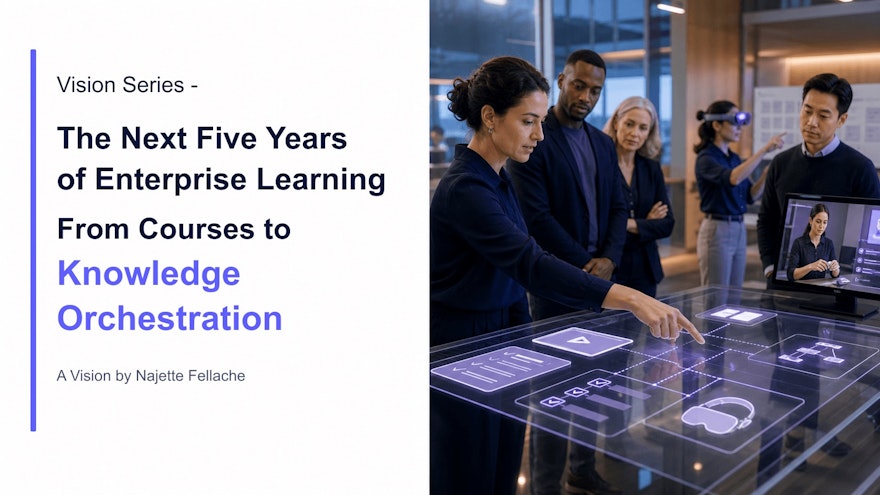
I believe we are moving from managing learning content to orchestrating trusted knowledge—capturing it at the source, maintaining it continuously and delivering the exact support someone needs to perform.
Today, most companies still treat training as something they create. Subject-matter experts write documents. Instructional designers transform those documents into courses. Employees complete the courses. The learning-management system records the completion, and everyone moves on until the next revision.
That model solved an important distribution problem. It allowed organizations to assign consistent training to thousands of people and preserve a record that it happened. But it was designed for a world in which content changed relatively slowly, expertise could be scheduled, and a course was the main container for learning.
That is no longer the world we work in.
The World Economic Forum’s Future of Jobs Report 2025 found that employers expect 39% of workers’ current skill sets to change or become outdated by 2030. Eighty-five percent of surveyed employers expected to prioritize upskilling. At the same time, LinkedIn’s 2025 Workplace Learning Report found that 49% of learning and talent-development professionals felt pressure from a skills crisis.
We cannot meet that pace by making the existing course factory run a little faster. We need a different operating model.
Why the course factory is reaching its limit
The traditional workflow is full of handoffs. An L&D team waits for an expert interview, drafts a storyboard, waits for comments, develops a course, sends it through another review and publishes it. When the source changes, much of that sequence begins again.
AI has already accelerated pieces of the workflow. The AI in Learning & Development Report 2026, based on a survey of 421 L&D professionals, reports that 87% are using AI. The heaviest use is still in production: text-to-speech was reported by 63%, quiz generation by 60%, video creation by 52% and translation or localization by 38%.
Those are valuable gains. But automating production inside the same chain does not remove the structural problem. The knowledge still has to arrive in a usable form. The course can still be outdated before its audience needs it. And faster generation can produce more content without producing better performance.
Dr. Philippa Hardman describes one part of this problem as the SME bottleneck. In her 2025 State of Instructional Design research with Synthesia, involving more than 400 practitioners, 30% cited SME delays as a barrier to speed and 13% as a barrier to quality. She argues, importantly, that this is not only an access problem. It is an articulation problem.
Even when experts are available, they do not automatically explain everything that makes them expert. Years of experience compress steps and judgments until they feel obvious. A person remembers the conclusion but may no longer be conscious of every cue that led there.
Shift 1: AI will capture expertise at the source
I believe the first major shift will be from asking experts to document what they know to capturing knowledge while they work.
Imagine an expert performing a task as part of a normal day. An AI agent observes the screen or physical workflow, listens to the explanation, links the activity to the relevant procedure and asks questions a new employee would ask:
- Why did you do it that way?
- What made you reject the other option?
- What mistake are you trying to avoid?
- What would look normal to a beginner but worry you?
- What changes for another product, customer, site or condition?
- When should someone stop and ask for help?
This is not simply automated transcription. It is structured elicitation connected to evidence from the work itself.
A frequently cited study in procedural teaching shows why that matters. In a 2014 study of three expert surgeons teaching a procedure, the experts omitted an average of 71% of clinical knowledge steps, 51% of action steps and 73% of decision steps when compared with a collaboratively developed task list. Structured cognitive-task-analysis prompts increased the average portion of described steps from 44% to 66%. The sample was very small and the domain was surgery, so the percentages should not be generalized to every workplace. The finding still illustrates a familiar truth: experts unintentionally leave out knowledge that has become automatic. The original study is available through PubMed.
AI can make those probing questions consistent and available. It can compare what the expert did with what the approved source says. It can flag a difference for review, identify an unexplained decision and ask for a counterexample. It can also combine multiple traces—video, clicks, equipment data, annotations and documents—so the organization is not relying on memory alone.
The biggest opportunity is preserving intellectual capital before it disappears. But the goal should not be to create a digital clone of one expert. It should be to convert individual experience into reviewed organizational knowledge, with its assumptions, scope and evidence visible.
Shift 2: Learning will be assembled, not simply published
Once knowledge is captured and structured, the course no longer has to be the default container.
One employee may need a two-minute demonstration before a task. Another may need an annotated image that highlights the cue to notice. A new hire may need a coherent pathway with explanation, practice and feedback. An experienced operator returning to an infrequent task may need a checklist. A supervisor may need a scenario about an exception. Someone preparing for a high-risk intervention may need a simulation and observed practice.
AI will increasingly assemble those experiences dynamically using the person’s role, authorization, location, task, prior performance, language, accessibility needs and the consequence of error. It can choose among formats and levels of support without pretending that every person belongs to a fixed “learning style.” Preferences matter, but the format must first fit the information and the performance requirement.
This is what I mean by knowledge orchestration: the coordinated capture, validation, transformation, delivery and maintenance of knowledge across its lifecycle. The system does not ask, “Which course should I assign?” It asks, “What is this person trying to accomplish, what do they already know, what evidence is applicable and what support will help them perform correctly now?”
Fixed courses will not disappear. They remain useful when people need a shared foundation, a coherent argument, protected practice or formal qualification. Their monopoly will disappear. A course becomes one possible experience among many, assembled from a governed knowledge base.
The practical design challenge will shift from producing screens to defining rules:
- Which source is authoritative for this role and context?
- What must be understood before guidance is used?
- What can be looked up, and what must be recalled immediately?
- When is video sufficient, and when is practice required?
- What evidence shows readiness?
- When must the system refuse, escalate or involve a human?
Shift 3: AI agents will maintain living knowledge
Creation receives most of the attention today. Maintenance may become the more important transformation.
When an SOP changes, the future learning system will not simply email L&D and add a ticket to a queue. An agent will identify the changed clauses, map the affected tasks and roles, locate every linked training asset, translation, assessment, video and job aid, and propose an update package.
For one role, the change may require a short delta briefing and acknowledgement. For another, it may alter a critical decision and require new practice. For a third, it may have no effect. The system can generate drafts, explain the source-to-output differences, create regression checks and submit the package into the existing review and approval workflow.
Humans remain responsible for validation and governance. That is not a ceremonial “human in the loop.” Quality, process owners and learning professionals need adequate context, explicit acceptance criteria and the authority to reject the output. The AI should preserve traceability: source version, transformation, reviewer decisions, effective date and affected audience.
We should also remain realistic about agent maturity. A 2025 Gartner survey of 360 IT application leaders found that only 15% were considering, piloting or deploying fully autonomous agents. PwC’s 2025 survey of 300 senior executives found strong budget intent—88% said their team or function planned to increase AI-related budgets because of agentic AI—but budget is not the same as safe operational capability.
Over the next five years, the winning systems will not be the most autonomous. They will be the most governable: bounded tasks, clear permissions, observable actions, reliable rollback, evaluation against real cases and human gates where consequences require them.
Shift 4: Learning and execution will converge
Enterprise learning has traditionally been separated from work. Employees leave the workflow, enter a course, complete it and return to the job. The hope is that the right knowledge comes back with them.
In the future, the distinction between learning and performance support will become less rigid. Training will still prepare people before they act. But guidance will also appear inside the tools, equipment and moments where knowledge is needed.
A technician scans an asset and sees the applicable visual workflow. A quality specialist asks a question and receives an answer grounded in the currently approved source, with the relevant passage visible. A new manager rehearses a difficult conversation with an AI coach, receives feedback and tries again. An operator sees only the steps, warnings and decision logic relevant to the current configuration.
The system can learn from execution without treating employees as passive data sources. Repeated questions may reveal a weak instruction. Frequent overrides may reveal a poor recommendation. A cluster of errors after a change may indicate that the content, process or environment—not the learner—needs attention.
This is the movement from knowledge management to knowledge execution: not simply storing what the organization knows, but helping people apply the right approved knowledge in the right context and preserving evidence of what happened.
Shift 5: Immersive practice will become more precise
I do not believe mixed reality will replace video. Video remains one of the fastest and most scalable ways to show a process, an expert demonstration or a visual standard. Images, diagrams and digital job aids are often the right answer too.
Immersive environments become powerful when observation is not enough—when employees need spatial understanding, muscle memory, coordinated action or safe exposure to a rare and consequential event.
Imagine practicing a cleanroom intervention without risking a batch, assembling critical equipment before touching the real asset, responding to a quality event with multiple signals, or maintaining machinery that cannot be taken offline for training. The employee can act, make a mistake safely, receive real-time guidance and repeat until performance stabilizes.
A 2025 systematic review and meta-analysis of mixed reality in vocational education and training found promising effects across behavioral, cognitive and affective outcomes. The authors also reported substantial unexplained variation and a lack of comparative research on instructional features. That is exactly the caution enterprise buyers need: immersion is not an instructional strategy by itself.
The orchestration layer should choose immersive practice only when it serves the task. A headset is unnecessary for a policy definition. It may be valuable for a spatial procedure, hazardous scenario or expensive equipment interaction. Video can prepare the learner; simulation can build and test performance; a job aid can support later execution.
The role of L&D will move upstream
If AI captures, drafts, translates, assembles and maintains content, what remains for learning professionals?
The most important work.
L&D will spend less time moving content from document to course and more time diagnosing performance, designing the knowledge system and protecting its quality. The role will involve:
- deciding whether a problem requires learning, workflow change or something else;
- designing questions that surface expert judgment and novice misconceptions;
- defining learning and performance outcomes;
- choosing when explanation, practice, guidance or assessment is appropriate;
- setting evaluation standards for AI-generated experiences;
- designing human approval and escalation points;
- measuring whether support changes real execution;
- ensuring accessibility, fairness, privacy and responsible data use.
Hardman’s analysis reaches a related conclusion: AI can reduce parts of the SME bottleneck, but it does not make pedagogical judgment or human expertise irrelevant. In fact, fluent AI output makes judgment more important because an incomplete or incorrect explanation can look finished.
Subject-matter experts will change too. They will spend less time recreating the same explanation and more time validating captured knowledge, resolving edge cases, coaching difficult judgment and improving the standard itself.
What enterprise leaders should build now
This future does not require a five-year technology bet. It requires foundations that create value now and make more advanced orchestration possible later.
| Build now | Why it matters later |
|---|---|
| Authoritative sources with owners, versions and applicability metadata | Agents cannot deliver trusted guidance if they cannot identify what is current and relevant |
| Links between SOPs, tasks, roles, training and job aids | Change-impact analysis depends on those relationships |
| A repeatable method to record expert skills | Ambient capture still needs purpose, consent, context and validation |
| Role-based learning and point-of-work support | Dynamic orchestration begins with understanding who needs what and when |
| Evaluation sets based on real questions, tasks and exceptions | AI quality cannot be governed with a generic accuracy score |
| Human approval, traceability and change control | Automation becomes scalable when its actions are reviewable and reversible |
| Performance measures beyond completion | The system needs feedback about execution, not only content consumption |
Begin with one bounded workflow. Capture one expert skill, connect it to an approved source, create two role-specific outputs, test them with real users and measure a performance outcome. Then simulate a source change. Can the organization find every affected asset? Can it generate a proposed delta? Can a reviewer understand and approve the change?
That exercise will teach more than a broad “AI for learning” pilot because it tests the entire knowledge lifecycle.
Governance should be designed with the workflow, not added after it. Define what the agent may observe, which data it may retain, which sources it may use, what it may publish, where human approval is mandatory and how a person can challenge or correct the system. In regulated environments, intended use and risk determine the level of validation and evidence required.
From managing knowledge to making it executable
Ultimately, I do not think the future of learning is about producing more courses.
It is about creating intelligent systems that capture expertise as it happens, preserve what the organization cannot afford to lose, and deliver exactly the support each person needs—through video, images, guided workflows, simulations, mixed reality or a conversation with an AI coach—at the moment it helps them perform safely and confidently.
The content will not be static. The experience will not be one-size-fits-all. And the learning function will not be measured by the size of its catalog.
We are moving from managing knowledge to making knowledge instantly executable. That is the shift that excites me most—and the one I believe will redefine enterprise learning over the next five years.
Frequently asked questions
What is knowledge orchestration in enterprise learning?
It is the coordinated capture, validation, transformation, delivery and maintenance of organizational knowledge. Instead of producing one fixed course, the system assembles approved training and guidance for a specific person, task and moment.
Will AI replace instructional designers?
AI will automate more production and maintenance work. Instructional designers remain essential for diagnosing performance needs, designing practice, evaluating evidence, setting quality standards and governing where human judgment is required.
How can AI capture tacit knowledge from experts?
AI can combine observation, screen or video capture, transcripts, documents and structured follow-up questions about cues, alternatives, mistakes and exceptions. Experts and accountable owners must still validate the resulting knowledge.
Will employees stop taking courses?
No. Courses remain useful for coherent foundations, qualification and shared experiences. Their monopoly will decline as more learning is assembled dynamically and delivered as video, scenarios, checklists, simulations or source-backed guidance in the workflow.
What role will mixed reality play?
Mixed reality is particularly useful when employees need spatial understanding, procedural rehearsal or safe practice on costly, dangerous or unavailable equipment. It complements rather than replaces scalable formats such as video and digital job aids.
Sources and further reading
- Dr. Philippa Hardman: Has AI Finally Fixed L&D’s SME Problem?
- Synthesia and Dr. Philippa Hardman: AI in Learning & Development Report 2026
- Sullivan et al.: Cognitive task analysis and expert instructional omissions
- World Economic Forum: Future of Jobs Report 2025
- LinkedIn: 2025 Workplace Learning Report
- PwC: 2025 AI Agent Survey
- Gartner: 2025 survey on fully autonomous AI agents
- 2025 meta-analysis of mixed reality in vocational education and training
Build the path from knowledge to execution
Speach transforms approved SOPs, procedures and expert knowledge into role-based training, video guidance, assessments, visual workflows and digital job aids. With multilingual delivery, review workflows, version control, auditability and enterprise integrations, organizations can move beyond course production toward continuously governed knowledge execution. Request a demo to explore the next generation of enterprise learning.