Pharmaceutical SOP training often fails in the space between an approved document and real execution. Employees may complete read-and-sign assignments yet still struggle with long procedures, role ambiguity, physical tasks, frequent changes or access at the point of work. Video can help, but only when it remains connected to the controlled source and the organization’s qualification process. These five challenges show where visual instruction adds genuine value—and where governance must remain firmly human.
Challenge 1: long SOPs hide role-relevant actions
A controlled procedure may contain responsibilities, rationale, definitions, references and steps for several functions. Assigning the entire document to every audience creates cognitive load and makes critical actions difficult to retrieve. Map the source by role, then create concise learning paths that preserve required context while emphasizing what each person must recognize, perform, record and escalate. Role-based training should point back to the approved SOP rather than become a parallel policy.
Challenge 2: physical work is difficult to learn from prose
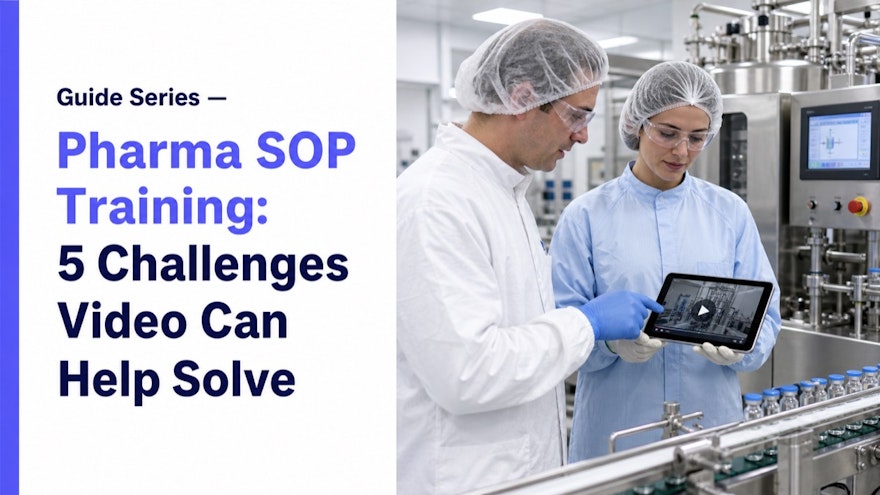
Text is precise for limits and responsibilities, but movement, orientation and visual inspection often benefit from demonstration. Use close-ups for connection points, sequence for gowning or setup and contrasting examples for acceptance criteria. Keep exact specifications in controlled text where they can be updated safely. A video should clarify the behavior, not embed uncontrolled values or hide a warning in narration.
Challenge 3: employees forget before they perform
Training delivered weeks before a rare task is vulnerable to forgetting. Provide a short refresher, visual workflow or approved job aid at the moment of need. The employee must still meet qualification requirements; point-of-work support does not replace competence. It reduces search and helps the performer confirm critical steps when the task occurs.
Challenge 4: SOP changes create content debt
A revised SOP can affect scripts, captions, translations, assessments and job aids. Store source ID and version with every derivative. Compare old and new steps, identify affected roles and choose acknowledgement, delta training or requalification according to risk. SOP-to-training generation can accelerate updates, but qualified owners must interpret and approve them.
Challenge 5: completion is mistaken for effectiveness
Completion proves an assignment event, not correct performance. Use scenario questions, demonstration, observation and relevant quality measures. Investigate recurring errors to determine whether the cause is knowledge, equipment, workload, process design or access. FDA quality-systems guidance emphasizes evaluating training effectiveness and verifying skills in day-to-day performance.
Practical focus
Pilot with one procedure that has a visible execution problem. Baseline deviations, questions, ramp time or observed errors; define the behavior that a visual resource should change; then test it with representative employees. Review the result with Operations and Quality before scaling. This prevents video from becoming a cosmetic layer over an unclear or unstable process.
Review the method with the people who perform the work, their manager and the appropriate technical or control owners. Capture questions, uncertainty and environmental constraints. Those signals reveal whether the solution needs better content, more practice, different access or a process change.
Before you scale
Run the method with one representative process, one role and a measurable baseline. Test retrieval and use in the real environment, not only during review. Document ownership, approval, access, language and change triggers. Confirm that employee feedback reaches the responsible process owner and that obsolete guidance can be withdrawn quickly.
Scale only after the pilot demonstrates both usefulness and control. Recheck devices, permissions, terminology, local variation, assessment and support at each new site or audience. The goal is a repeatable capability that remains trustworthy as content volume grows—not a campaign that produces assets faster than the organization can maintain them.
Implementation playbook
Select a high-consequence SOP
Prioritize a stable procedure with measurable quality, safety or readiness pain. Define the accountable owner, evidence and review point before expansion.
Map roles and critical actions
Separate shared context from role-specific decisions, steps and records. Define the accountable owner, evidence and review point before expansion.
Storyboard from the source
Link every scene to an approved step, warning, key point or reason. Define the accountable owner, evidence and review point before expansion.
Validate in the work environment
Test accuracy, usability, device access and qualification needs. Define the accountable owner, evidence and review point before expansion.
Release with traceability
Record source version, owner, approval, audience, language and status. Define the accountable owner, evidence and review point before expansion.
Measure and maintain
Use performance evidence and change triggers to update or withdraw content. Define the accountable owner, evidence and review point before expansion.
Employees can find the current guidance, understand critical decisions and demonstrate the required behavior. Owners can trace each asset to its source, audience and approval. Workplace feedback produces governed improvement, and approved changes reach every affected format without leaving outdated alternatives behind.
A risk-based decision framework
Use video when visual demonstration solves a defined comprehension or execution problem. A low-risk terminology update may need a concise communication. A new aseptic manipulation, inspection technique or system workflow may need demonstration, practice and observed qualification. Match the intervention to task complexity, consequence of error, experience and frequency.,Keep the medium honest. A video cannot correct missing tools, conflicting procedures, unrealistic production targets or an unstable process. When the pilot reveals those conditions, route them to the process owner instead of adding more explanation. Training should make the approved method executable, not normalize workarounds.,For multilingual populations, control the source script and terminology before translation. Review critical warnings, product terms, equipment names and escalation language in context. Test captions and narration on the actual device and in the noise conditions where employees will use them.
Apply it in the operating system
Audit the employee path from assignment to task. Confirm that role mapping, prerequisite qualification, device access, supervisor coaching and point-of-work support agree with the approved procedure. Review deviations and help requests by step rather than treating every failure as a general training issue. This sharper diagnosis leads to targeted content and avoids retraining people on knowledge they already possess.
Evidence and governance checklist
Record the problem, audience, approved source, owner, review path and expected performance evidence before production begins. During the pilot, collect observations and employee questions as well as usage data. After release, compare the chosen operational measure with its baseline and investigate alternative causes before claiming impact.
Maintain a traceable relationship among the source, published formats, translations, assessments and qualification records. Define the events that trigger review, including process, equipment, system, regulatory and organizational changes. Reliable maintenance is part of content quality: employees should never have to choose between multiple versions of an operational answer.
Operational readiness review
Before wider release, confirm that the content works under normal production pressure. Test the exact device, authentication, language, noise, protective equipment and network conditions. Make help and escalation visible. Verify that supervisors understand how the resource fits with practice, assessment and authorization, and that employees know which source is controlling when uncertainty remains.
Schedule a short post-launch review with frontline users and the process owner. Examine failed searches, repeated questions, assessment patterns and the operational measure. Decide whether to improve the content, change access, add coaching or correct the underlying process. Document the decision and the person responsible for follow-through.
Questions for the final review
Can the intended employee find this resource without knowing its internal title? Is every important action visible or stated, and is every warning placed before the behavior it governs? Does the resource distinguish mandatory controls from helpful explanation? Can reviewers trace it to a current owner and source? Is the response to an exception explicit? Does the success measure test workplace performance rather than exposure alone? A clear answer to these questions is a stronger release criterion than production polish.
Frequently asked questions
Do video SOPs replace controlled SOPs?
Normally no. The approved SOP remains the source; video and visual guidance support understanding and execution.
Is watching a video sufficient for GxP qualification?
Not necessarily. Match assessment and demonstration requirements to the role and process risk.
How long should pharma training videos be?
Focus each resource on one task or decision and use chapters when employees need targeted retrieval.
Can AI generate the video?
AI can accelerate extraction and production, while qualified humans validate accuracy, risk controls and approval.
How should updates be handled?
Run change-impact analysis across every linked format, assign targeted training and withdraw obsolete versions.
Sources and further reading
These authoritative sources support the regulatory, workforce, accessibility or training context. Apply them through your organization’s approved processes.
Turn training into confident execution
Speach transforms procedures and expert knowledge into role-based training, videos, workflows, assessments and job aids. Explore knowledge execution or request a demonstration.