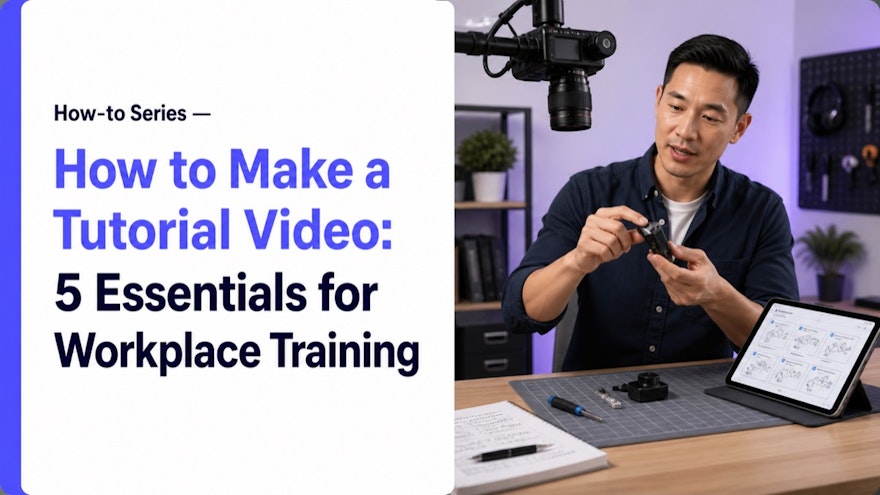
A useful tutorial video helps someone perform a defined task with less uncertainty. It is not a recorded presentation, a marketing film or unedited expert footage. Workplace tutorials need a clear outcome, a learner-centered view, concise explanation, accessible delivery and evidence that the instruction works. These five essentials provide a repeatable production method for corporate, manufacturing and regulated teams.
Essential 1: one observable outcome
Define what the viewer should be able to do after watching. “Create a deviation record with the required fields” is stronger than “understand the deviation system.” Narrow outcomes produce better titles, storyboards and assessments. If the task contains several independent goals, create a short series rather than one long video.
Essential 2: a storyboard based on the real task
Map the trigger, prerequisites, steps, key points, reasons, decisions, warnings and end state. For controlled work, identify the approved source and version. The storyboard protects sequence and tells the camera operator where a close-up, screen capture or contrasting example is needed. It also exposes missing information before recording begins.
Essential 3: visuals from the learner’s viewpoint
Show the action at the scale and angle needed to perform it. Use stable framing, readable screens and close-ups for orientation or inspection. Remove confidential information and record in a safe, representative condition. Narration should add reasoning and warnings instead of describing every movement the viewer can already see.
Essential 4: concise and accessible delivery
Use short chapters, captions, transcripts and large high-contrast labels. W3C notes that captions communicate speech and meaningful sound and help in noisy environments as well as supporting people with hearing, cognitive or learning needs. Keep music and decorative motion from competing with instruction. Validate translations and technical terms.
Essential 5: testing and controlled release
Ask a representative user to locate the video and perform the task. Observe hesitation, rewinds and questions. Have the process owner verify accuracy and route higher-risk content through the appropriate safety, Quality, privacy or compliance review. Publish an owner, status and review trigger with the resource.
Practical focus
The fastest way to improve production is to separate raw capture from the published tutorial. Let the expert demonstrate naturally, then edit the validated knowledge into a focused resource. Preserve the full source when useful for review, but do not make employees search through it. Training video creation can accelerate editing, captions, translation and interactive checks while keeping reviewers in control.
Review the method with the people who perform the work, their manager and the appropriate technical or control owners. Capture questions, uncertainty and environmental constraints. Those signals reveal whether the solution needs better content, more practice, different access or a process change.
Before you scale
Run the method with one representative process, one role and a measurable baseline. Test retrieval and use in the real environment, not only during review. Document ownership, approval, access, language and change triggers. Confirm that employee feedback reaches the responsible process owner and that obsolete guidance can be withdrawn quickly.
Scale only after the pilot demonstrates both usefulness and control. Recheck devices, permissions, terminology, local variation, assessment and support at each new site or audience. The goal is a repeatable capability that remains trustworthy as content volume grows—not a campaign that produces assets faster than the organization can maintain them.
Implementation playbook
Choose the task
Use a stable process where visual explanation can change performance. Define the accountable owner, evidence and review point before expansion.
Write the outcome
Name the action, audience, conditions and acceptable result. Define the accountable owner, evidence and review point before expansion.
Create the storyboard
Map source steps, visuals, key points, reasons and warnings. Define the accountable owner, evidence and review point before expansion.
Record clean evidence
Capture safe, legible action and useful expert explanation. Define the accountable owner, evidence and review point before expansion.
Edit for retrieval
Add chapters, captions, transcript and concise overlays. Define the accountable owner, evidence and review point before expansion.
Test and govern
Validate with users, approve where required and maintain after change. Define the accountable owner, evidence and review point before expansion.
Employees can find the current guidance, understand critical decisions and demonstrate the required behavior. Owners can trace each asset to its source, audience and approval. Workplace feedback produces governed improvement, and approved changes reach every affected format without leaving outdated alternatives behind.
A practical pre-publication checklist
Before recording, confirm the audience, safe conditions, permissions, source material and reviewer. Prepare the workspace so the real method is visible, not an idealized demonstration that omits normal constraints. Capture a wide orientation view, then only the close-ups needed to understand action or judgment.,During editing, preserve the true sequence while removing dead time. Keep on-screen text brief, synchronized and away from the action. If a parameter changes frequently, place it in a controlled reference instead of recording it permanently. Include the escalation path for conditions the learner should not resolve alone.,Before release, test the tutorial on the real device, connection and screen size. Ask a representative employee to locate it from a realistic query, perform the task and explain critical points. Correct every moment where the user guesses or has to search elsewhere.
Apply it in the operating system
Create a reusable production brief with outcome, audience, environment, source, visual requirements, accessibility, reviewer and success measure. The brief lets an expert, L&D partner and videographer make the same decisions without a long meeting. After publication, save the storyboard and editable source so a future owner can update one scene instead of rebuilding the tutorial.
Evidence and governance checklist
Record the problem, audience, approved source, owner, review path and expected performance evidence before production begins. During the pilot, collect observations and employee questions as well as usage data. After release, compare the chosen operational measure with its baseline and investigate alternative causes before claiming impact.
Maintain a traceable relationship among the source, published formats, translations, assessments and qualification records. Define the events that trigger review, including process, equipment, system, regulatory and organizational changes. Reliable maintenance is part of content quality: employees should never have to choose between multiple versions of an operational answer.
Operational readiness review
Before wider release, confirm that the content works under normal production pressure. Test the exact device, authentication, language, noise, protective equipment and network conditions. Make help and escalation visible. Verify that supervisors understand how the resource fits with practice, assessment and authorization, and that employees know which source is controlling when uncertainty remains.
Schedule a short post-launch review with frontline users and the process owner. Examine failed searches, repeated questions, assessment patterns and the operational measure. Decide whether to improve the content, change access, add coaching or correct the underlying process. Document the decision and the person responsible for follow-through.
Questions for the final review
Can the intended employee find this resource without knowing its internal title? Is every important action visible or stated, and is every warning placed before the behavior it governs? Does the resource distinguish mandatory controls from helpful explanation? Can reviewers trace it to a current owner and source? Is the response to an exception explicit? Does the success measure test workplace performance rather than exposure alone? A clear answer to these questions is a stronger release criterion than production polish.
Frequently asked questions
What makes a good tutorial video?
One clear outcome, useful visuals, concise explanation, accessibility, representative testing and accountable ownership.
How long should it be?
As short as the defined outcome allows; split independent tasks or use chapters.
Do I need professional equipment?
Clear action, stable framing, good audio and safe conditions matter more than an expensive camera.
Should the expert read a script?
Use a storyboard and talking points; natural explanation often reveals useful reasons and cautions.
How is success measured?
Test whether users can find and perform the task, then monitor questions, errors, time and confidence.
Sources and further reading
These authoritative sources support the regulatory, workforce, accessibility or training context. Apply them through your organization’s approved processes.
Turn training into confident execution
Speach transforms procedures and expert knowledge into role-based training, videos, workflows, assessments and job aids. Explore knowledge execution or request a demonstration.