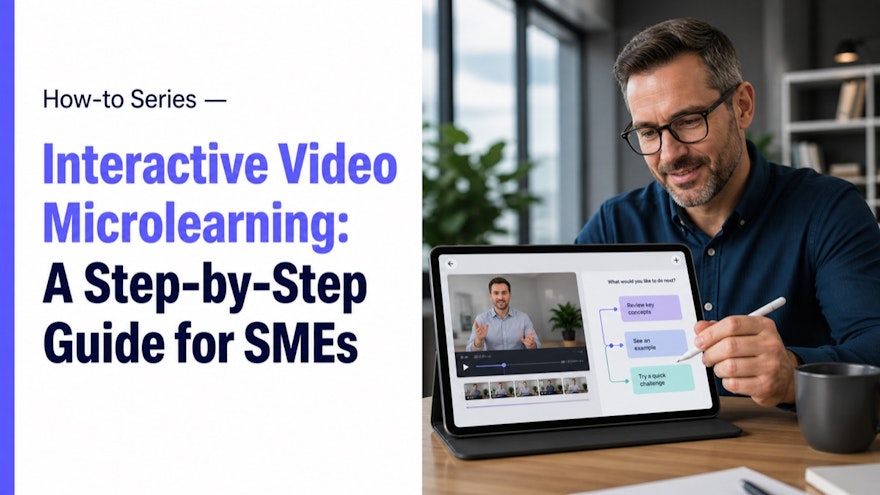
Interactive video microlearning works when a short resource helps an employee make a decision or perform a focused part of work. “Short” and “interactive” are not quality guarantees. The subject-matter expert still needs a precise outcome, accurate source, realistic scenario and useful feedback. This guide turns expert knowledge into small learning experiences without asking SMEs to become instructional designers.
Step 1: choose one moment of performance
Select a task, decision or recurring mistake connected to an operational outcome. Identify the role, prerequisites and context. Avoid compressing an entire procedure into five minutes. A focused objective makes the interaction meaningful and the resource reusable at the moment of need.
Apply this principle to a representative task, then verify it with the people who perform and own the work. Record the decision, evidence and next review trigger before expanding it.
Step 2: capture the expert’s reasoning
Ask the SME to demonstrate or explain the work, then probe for cues, alternatives, common errors and escalation. Separate approved requirements from personal preference. Use the record-a-skill method for tacit knowledge that is normally skipped.
Apply this principle to a representative task, then verify it with the people who perform and own the work. Record the decision, evidence and next review trigger before expanding it.
Step 3: design purposeful interaction
Add a question where the learner must notice, choose, sequence or predict—not simply click Next. Use realistic consequences and feedback that explains the key point and reason. Branch only when alternative decisions genuinely matter. Too many interactions can interrupt understanding.
Apply this principle to a representative task, then verify it with the people who perform and own the work. Record the decision, evidence and next review trigger before expanding it.
Step 4: produce accessible media
Show the action clearly, caption speech and meaningful sound, use high-contrast text and provide searchable transcripts. Keep modules task-sized and group them into a path when prerequisites matter. A 2024 systematic review describes microlearning as bite-sized, just-in-time learning but also emphasizes implementation context.
Apply this principle to a representative task, then verify it with the people who perform and own the work. Record the decision, evidence and next review trigger before expanding it.
Step 5: validate and publish
Have the SME confirm fidelity, involve relevant owners and test with representative learners. For controlled work, store source, version, approval and audience. Interactive training video tools can accelerate production while preserving review.
Apply this principle to a representative task, then verify it with the people who perform and own the work. Record the decision, evidence and next review trigger before expanding it.
Step 6: measure and improve
Review responses, replay points, questions and the closest performance outcome. A frequently missed question may reveal unclear content, a poor distractor or a real process gap. Update the resource and withdraw obsolete versions after source changes.
Apply this principle to a representative task, then verify it with the people who perform and own the work. Record the decision, evidence and next review trigger before expanding it.
Practical application
A useful microlearning pattern is context, demonstration, decision, feedback and transfer. Set the situation in one sentence, show the critical behavior, ask the learner to make the relevant choice, explain the result and end with where the employee finds approved support. This structure respects attention without stripping away the reason that makes knowledge transferable.
Set a baseline and write the expected mechanism before launch: what should people do differently, and why should that behavior change the selected outcome? Review the result with users, managers and appropriate control owners. This protects against confusing engagement with effectiveness.
Implementation and governance checklist
Before production, record the problem, audience, approved source, owner, review path, access conditions and expected performance evidence. During the pilot, observe representative employees in the real environment. Collect questions, failed searches and points of hesitation as well as usage data. Decide whether the answer is better content, more practice, different access or a process change.
Before scaling, confirm source traceability, versioning, translation, accessibility, permissions and withdrawal of obsolete guidance. Define the events that trigger review and the manager’s role in practice or qualification. Recheck those assumptions for every new site, language or role. Growth should preserve trust and usefulness rather than multiply content faster than it can be maintained.
Implementation playbook
Write the micro-outcome
Define the role, behavior, condition and standard. Confirm ownership and success evidence.
Collect source evidence
Capture approved steps, expert cues, errors and escalation. Confirm ownership and success evidence.
Storyboard the interaction
Place questions only where decisions or recall matter. Confirm ownership and success evidence.
Create the video
Use clear visuals, captions, transcript and concise narration. Confirm ownership and success evidence.
Review and test
Validate accuracy, usability, accessibility and governance. Confirm ownership and success evidence.
Publish and monitor
Track performance evidence and maintain after change. Confirm ownership and success evidence.
Employees can find the current guidance, explain critical choices and demonstrate performance. Owners can trace every asset to its source and audience. Feedback reaches the process owner, approved changes update affected formats and outdated alternatives disappear from use.
Apply the approach responsibly
Create a short series map before producing individual microlearning. Mark prerequisites, shared concepts, role paths and the approved support employees use afterward. This keeps short modules connected and prevents learners from receiving fragments without context. Reuse validated source blocks rather than copying text into multiple assets.
Operational readiness review
Test the complete employee journey: discovery, access, comprehension, practice, performance and feedback. Use the normal device, account, language, shift conditions and protective equipment. Verify that the resource states its audience and status, that the controlling source is clear and that escalation is available when the situation falls outside the instruction.
After launch, schedule a review using failed searches, questions, observation, assessment patterns and the closest operational measure. Investigate alternative causes before assigning credit or blame to training. Decide whether to improve the resource, strengthen coaching, change access, correct the process or retire content that no longer serves a defined need.
Document each decision and owner. A reliable content system is defined as much by update and withdrawal behavior as by initial production quality. Employees should never need to choose between multiple apparently valid answers.
Questions for the final review
Can a representative employee find the resource using their normal words rather than its internal project name? Does every important action have enough visual or written precision? Are warnings placed before the behavior they govern? Can the employee recognize when the instruction does not apply and where to escalate? Does the design work without ideal bandwidth, audio or uninterrupted attention?
Can an owner trace the resource to a current source, approval, audience and language? Are mandatory controls clearly separated from examples and helpful tips? Is there a realistic practice or qualification method for the risk involved? Can obsolete versions be removed promptly? Finally, does the success measure test the workplace behavior or result the resource was designed to change? A clear answer to these questions is a stronger release criterion than production polish or learner preference alone.
Frequently asked questions
What is interactive video microlearning?
A short video-based learning experience that requires a meaningful learner response and provides feedback.
How long should it be?
As short as the focused outcome allows; do not remove required context to meet a time limit.
What interactions work best?
Decisions, sequencing, recognition, prediction and teach-back tied to real performance.
Can SMEs create it directly?
Yes, with templates, facilitation and validation by appropriate owners.
How do we avoid fragmentation?
Connect modules through prerequisites, role-based paths, search and a governed source.
Sources and further reading
These authoritative sources support the research, workforce, accessibility or training context. Interpret them for your organization and process.
Turn knowledge into confident execution
Speach transforms procedures and expert knowledge into role-based training, visual workflows, assessments and job aids. Explore knowledge execution or request a demonstration.