The most valuable manufacturing knowledge is often difficult to find in a manual. It lives in the decisions, observations and techniques of experienced frontline employees. This guide explains how to capture that expertise without disrupting production—and convert it into guidance other employees can use safely and consistently.
Why factory-floor knowledge capture matters now
Manufacturers are adopting automation, connected equipment and AI while experienced employees retire, move roles or become responsible for more complex processes. The World Economic Forum’s Future of Jobs Report 2025 finds that nearly 40% of skills required on the job are expected to change by 2030. It also reports that 63% of surveyed employers see skills gaps as a main barrier to transformation.
The challenge is not merely storing more information. It is preserving the practical knowledge needed to recognize a problem, choose the correct response and execute work under real conditions. A recent NIST analysis of the Manufacturing USA Occupation and Competency Framework, published in June 2026 using 2025 data, identifies 132 advanced-manufacturing occupations connected to 235 knowledge, skill and ability requirements. That breadth makes an informal “ask the expert” model increasingly difficult to scale.
A structured knowledge-capture program turns expertise into a managed operational asset. It supports onboarding, cross-training, standardized work, problem-solving and continuity across sites. In regulated environments, it must also preserve the relationship between practical guidance and approved procedures.
Explicit, implicit and tacit knowledge
Explicit knowledge is already articulated: an SOP, work instruction, specification, checklist or diagram. Implicit knowledge is not yet documented but can usually be explained when someone asks the right question. Tacit knowledge is harder to express. It includes pattern recognition, sensory cues, judgment developed through experience and the subtle adjustments experts make when conditions change.
Consider a technician who hears a change in a motor before an alarm appears, an operator who recognizes a poor seal by appearance, or a quality investigator who knows which evidence will clarify a deviation. Simply recording the written steps will not capture those cues. The capture process must reveal what the expert notices, why it matters and when the normal sequence no longer applies.
1. Prioritize the knowledge worth capturing
Start with a risk-based backlog rather than an open request for employees to “share what they know.” Score candidate topics by operational criticality, frequency, knowledge scarcity, turnover exposure, time to competence and stability of the process. Give priority to work where a small number of people hold essential expertise or where errors cause safety events, deviations, downtime, scrap or rework.
Useful evidence already exists in the organization: recurring downtime reasons, deviation and CAPA records, audit observations, maintenance logs, help-desk questions and supervisor feedback. Review these sources with Operations, Quality, EHS and L&D. Select one defined outcome, such as reducing support calls during a format change or making pre-use inspection knowledge available on every shift.
2. Observe experts doing real work
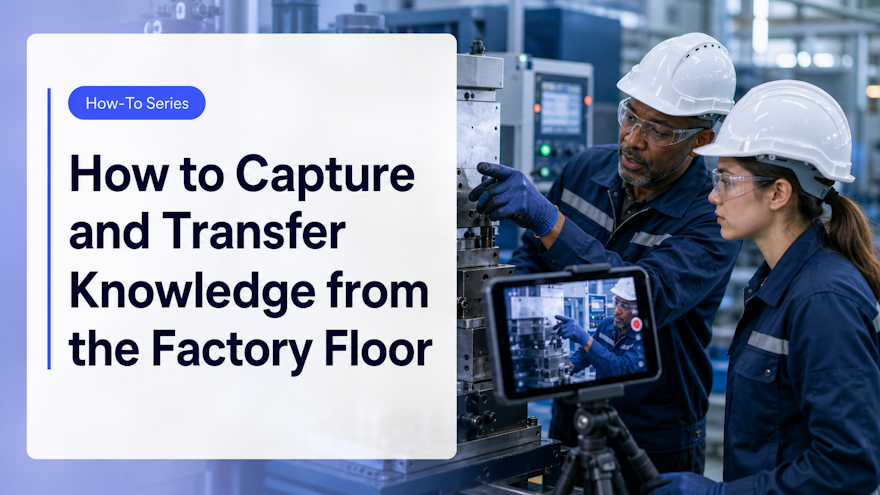
Interviews alone tend to produce a simplified version of the job. Observe the SME in context, with approval and without creating risk. Ask them to perform or simulate the task while explaining the purpose of each stage. Capture the equipment state, tools, PPE, hand positions, system screens and environmental conditions that influence the work.
Use a phone or tablet on a stable mount for short demonstrations. Record wide shots for context and close-ups for details. Avoid displaying confidential batch, employee or customer data. For hazardous or sterile operations, use an approved simulation, annotated images or a visual workflow when filming the live activity is inappropriate.
OSHA’s education and training guidance recognizes peer-to-peer learning, on-the-job training and worksite demonstrations as effective ways to convey hazards, controls and good work practices. Capturing expertise on the floor preserves that contextual strength, but the resulting media still needs role-specific training and supervised practice where required.
3. Ask questions that reveal expert judgment
Replace broad prompts such as “Explain how this works” with questions anchored in decisions:
- What do you check before starting, and what would make you stop?
- What changes when the material, product, tool or equipment state is different?
- Which warning signs do new employees usually miss?
- What is the most common error, and how do you detect it early?
- When do you escalate instead of troubleshooting?
- What does a correct result look, sound or feel like?
Use a second experienced employee to challenge assumptions and expose site or shift variations. Distinguish approved practice from personal preference. If the SME describes a workaround that conflicts with the controlled procedure, do not publish it as guidance. Route it to the process owner as a potential improvement or compliance issue.
4. Convert knowledge into formats employees can use
One capture session can produce several role-based assets. A short video can show motion and context. A visual workflow can guide decisions. A one-page job aid can summarize checks. An assessment can verify understanding, while a supervisor checklist can support observed qualification. Choose the smallest format that helps the employee perform correctly.
Keep each asset focused on one task or question and give it a descriptive title. Add metadata for role, site, equipment, product, language, risk and source-document identifier. Accurate captions and transcripts make video usable in noisy environments and easier to search. Translation should begin from an approved source, with technical terminology reviewed by a local SME.
Speach’s AI Training Generator helps teams convert documents and expert input into visual training, assessments and job aids. For practical production guidance, see best practices for SME instructional video libraries and software for creating training videos.
5. Validate, approve and govern the content
Knowledge captured from an expert is a draft, not automatically an approved instruction. Have another qualified person test it for technical accuracy and clarity. In safety-critical or regulated operations, include the process owner and the appropriate Quality, compliance or EHS reviewer. Confirm that the content points to the current SOP or work instruction and does not create a competing source of truth.
Assign an owner, version, approval status, effective date and review date. Define change triggers: a revised procedure, new equipment, material change, deviation trend, incident or regulatory update. Archive superseded versions while retaining the history. For medical-device manufacturers, the FDA’s Quality Management System Regulation became effective February 2, 2026, reinforcing the need to operate within a formal quality-management framework.
Speach’s security and compliance capabilities support controlled content, audit trails and enterprise governance. Organizations using validated life-sciences systems can also connect training workflows through relevant enterprise integrations.
6. Deliver guidance at the point of work
Captured knowledge creates value only when an employee can find the correct, current item in seconds. Organize the experience around the worker’s role and task, not the department that created the content. Use plain-language search terms and provide access through the device employees actually use: a shared workstation, rugged tablet, phone or approved QR code near the equipment.
Separate learning from execution when necessary. An onboarding pathway may explain principles and verify knowledge, while a short job aid supports the same employee during work. OSHA’s respiratory-training guidance illustrates why general video content does not replace worksite-specific training. High-risk tasks may still require demonstration, practice and evaluation by a qualified person.
The Speach mobile app supports access closer to the point of need, while role-based training helps deliver different guidance to operators, supervisors, quality personnel and maintenance teams.
7. Measure use and operational impact
Track more than views. Measure successful search, completion, assessment results and employee confidence, then connect them to the business outcome selected at the start. Relevant measures may include time to qualification, support requests, first-time-right rate, changeover time, repeat deviations, downtime, scrap or rework.
Search queries with no useful result reveal missing knowledge. Repeated rewinds may show a difficult step. Low adoption may indicate poor placement, weak titles or lack of supervisor support. Review these signals with frontline employees and use them to improve both the content and the underlying process. The World Economic Forum reports that employers most often expect training investment to enhance productivity and competitiveness; operational measures help demonstrate whether those expectations are being met.
A 30-day factory-floor knowledge-capture pilot
- Week 1: choose one role or process, identify three to five critical topics, name owners and define success measures.
- Week 2: observe SMEs, record demonstrations and extract decision points, warnings and common errors.
- Week 3: create modular video, workflow and assessment assets; add metadata, captions and source references.
- Week 4: validate with reviewers and representative learners, publish to a controlled audience and collect baseline feedback.
At the end of the pilot, evaluate content quality, time to create, retrieval speed and early operational results. Fix the workflow before scaling. A sustainable program combines frontline ownership with central standards, so experts can contribute quickly without sacrificing accuracy, safety or traceability.
When practical expertise becomes searchable, governed and connected to execution, the factory is less dependent on who happens to be available during a shift. Request a Speach demo to see how AI-assisted creation and enterprise controls can turn factory-floor knowledge into training and guidance.