Where employee-generated content adds value
The people closest to the work see details that centralized content teams cannot observe from a desk. They know which visual cue prevents a defect, which question new hires ask repeatedly and which equipment variation changes a setup. Employee-generated content (EGC) creates a channel for that experience to become visible, reusable and improvable.
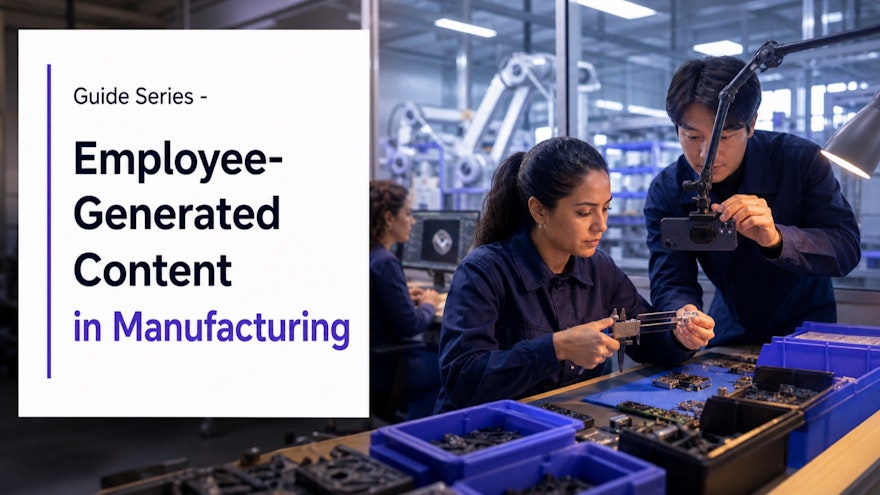
Useful formats include a maintenance expert demonstrating an inspection, an operator explaining an approved changeover tip, a quality specialist illustrating a documentation error, or a team recording the lesson from a completed improvement. The objective is not social-media volume. It is faster access to accurate context that helps employees learn and execute.
Worker voice also matters for safety. OSHA’s guidance on worker participation says workers often know the most about hazards associated with their jobs and recommends involving them in safe-work practices, procedures, training and program evaluation. Participation must never discourage formal hazard reporting or replace required safety processes.
EGC and manufacturing knowledge transfer are related but not identical. Knowledge transfer is the broader capability system. EGC is one creation model inside it. It works best when the organization distinguishes open contribution, reviewed learning and controlled work instructions.
Eight employee-generated content challenges—and how to solve them
1. Quality varies between contributors
The challenge: Experts may skip steps that feel obvious, use unexplained jargon or record a technically correct action from an angle that makes it impossible to learn. A polished video can still contain an incorrect sequence; a rough clip can contain valuable insight.
The solution: Standardize the brief, not the employee’s voice. Provide a short template: audience, objective, prerequisites, steps, critical points, exceptions, expected result and escalation. Add a framing checklist for lighting, sound, personal data and equipment visibility. Offer an editor or content coach for high-value topics. Review technical meaning separately from production quality.
2. Informal content can conflict with controlled instructions
The challenge: A local workaround, old equipment setting or draft improvement can be mistaken for the approved method. In regulated manufacturing, uncontrolled guidance can create quality, safety and audit risk.
The solution: Define content classes and label them visibly. A discussion, improvement proposal and approved job aid need different permissions and review. Link each governed asset to its authoritative source, owner and version. When the source changes, trigger an impact assessment and retire superseded derivatives. Speach’s security and compliance capabilities support approval, permissions, version control, audit trails and electronic signatures; the manufacturer remains responsible for validation and intended use.
3. Recording can expose safety, privacy or intellectual property
The challenge: A camera may capture a confidential formula, customer name, computer screen, badge, incident detail or unsafe staging. Employees may attempt to reproduce a dangerous condition for the sake of a demonstration.
The solution: Establish no-record zones, approved devices, consent rules and redaction procedures. Use simulations for hazardous, rare or emergency conditions. Require reviewers to check background details, PPE, guarding, ergonomics, data visibility and safe sequence—not merely the narration. Separate safety reporting from content contribution, and protect employees who raise concerns.
4. Employees say they do not have time
The challenge: Content creation competes with production, maintenance and quality priorities. Asking a high-performing employee to contribute “when you have a moment” makes the program dependent on unpaid enthusiasm.
The solution: Prioritize real operational needs and reserve work time. Capture at natural moments: a planned changeover, approved repair, recurring coaching session or post-improvement review. Provide a facilitator so the expert demonstrates while someone else records and structures the material. Start with a five-minute capture rather than a request to build a course.
Managers should track contribution workload and avoid repeatedly selecting the same expert. Recognition should reward usefulness and improvement, not raw upload counts. OSHA likewise recommends providing workers with the time and resources necessary to participate in safety programs.
5. Contributors fear criticism or strive for perfection
The challenge: Employees may believe they need presenter skills, flawless language or professional video production. Others fear that exposing a question or workaround will create blame.
The solution: Create psychological safety around drafts. Explain that editing and review are normal and that raising a discrepancy is useful. Let employees record a voiceover, hands-only demonstration or screen capture if they do not want to appear on camera. Give feedback against the template and operational objective, not the person’s accent or style.
Leaders should respond visibly to contributions and unresolved concerns. If employees share ideas but never learn what happened, participation will decline. Close every feedback loop with accepted, revised, deferred or rejected status and a reason.
6. Content becomes difficult to find
The challenge: A successful pilot can quickly create hundreds of vaguely titled videos. “Great tip from Mike” means little to a night-shift operator searching for a conveyor sensor reset.
The solution: Require plain-language titles and structured metadata: task, role, equipment, line, site, product, language, content type, owner and status. Use the vocabulary employees search, including approved synonyms. Deliver content through role-based training and point-of-work access, while preserving clear boundaries around qualification and authorization.
Measure failed searches and repeated questions. These reveal missing topics, poor labels or content that is technically present but not usable. Archive obsolete assets rather than leaving multiple versions visible.
7. Language, accessibility and digital confidence vary
The challenge: A program can amplify only the most confident, digitally fluent or dominant-language employees. Important knowledge from contractors, temporary workers or multilingual teams may remain unheard.
The solution: Support captions, transcripts, readable contrast, translation and multiple creation modes. Offer short practice sessions and local champions. The Speach mobile app can support creation and access near the work where permitted. Review translations with an approved glossary and knowledgeable target-language reviewer.
OSHA recommends removing language, education and skill barriers to meaningful participation and including contractors and temporary staffing workers. Design contribution pathways accordingly, while respecting employment, representation and site requirements.
8. Generative AI accelerates both creation and error
The challenge: AI can turn a source into a script, captions, questions, images or translations quickly. It can also invent a step, weaken a warning, expose confidential input or create a convincing but incorrect visual.
The solution: Limit AI to approved use cases and data. Preserve source traceability, disclose AI-assisted elements where required and assign a qualified human reviewer. Test outputs against the source and intended workplace context. NIST’s AI Risk Management Framework provides a voluntary structure for incorporating trustworthiness into AI design, use and evaluation; its Generative AI Profile identifies risks and suggested actions specific to generative systems.
Speach’s AI training generator can accelerate conversion of approved material into visual learning and assessments. AI should reduce production effort—not transfer accountability away from process, quality and safety owners.
A governed workflow for frontline content
Use a visible path from idea to use: request, triage, capture, edit, technical review, approval, publication, feedback and retirement. Assign an owner and service level at triage. A helpful peer tip may remain in a collaborative space; a high-risk work instruction needs formal control before employees rely on it.
During capture, record the objective, audience, location, source and contributor. During editing, remove unnecessary detail and add the visual cues, warnings and decision points learners need. During review, confirm accuracy, safe execution, confidentiality, accessibility and relationship to the controlled source. During publication, apply role, site, language, version and effective-date rules.
Training content should lead to practice when the objective is performance. NIST’s Training Within Industry guidance structures Job Instruction around preparation, demonstration, learner trial and follow-up. A frontline video can support showing and telling, but it does not replace supervised practice or qualification when those are required.
Choose controls according to content risk
| Content example | Typical risk | Proportionate control |
|---|---|---|
| Improvement story or team update | Low | Basic moderation, privacy and confidentiality check |
| Expert explanation of a concept | Low to medium | SME review, source links and review date |
| Equipment demonstration | Medium | Technical and safety review; role/site targeting |
| Troubleshooting decision guide | Medium to high | Defined limits, escalation, validation and version control |
| GxP or safety-critical instruction | High | Formal approval, controlled source, audit trail and required qualification |
| AI-generated translation or procedure visual | Depends on use | Source traceability plus human linguistic and technical verification |
Risk classification should follow the consequence of someone acting on the content, not how informal its format looks. A 30-second clip can direct a high-risk action; a long presentation may only communicate awareness.
How to measure an EGC program
Avoid making upload volume the headline metric. It rewards content accumulation and can encourage duplication. Track participation across roles, shifts, sites and languages; time from approved request to publication; review cycle time; search success; repeat use; feedback resolution; and the percentage of assets current and owned.
Then connect the program to the problem it was designed to solve. Depending on the use case, examine repeated expert questions, time to proficiency, first-time-right performance, rework, changeover consistency, downtime, deviations, safety observations or support demand. Define a baseline and follow-up period before launch.
Interpret results carefully. If a defect rate improves while equipment and staffing also change, report the combined context rather than attributing the outcome entirely to content. Segment results by content version and audience. A high completion rate with persistent errors is a signal to inspect the instruction, process, assessment and workplace—not simply assign more training.
Finally, measure trust: do employees know which content is authoritative, can they flag a problem, and do they receive a response? A smaller library that people trust and use is more valuable than thousands of ungoverned clips.
Frequently asked questions
What is employee-generated content in manufacturing?
It is practical learning or operational content created with frontline workers and SMEs, such as demonstrations, one-point lessons, troubleshooting guides and improvement stories.
Can employee-generated content replace SOPs?
No. It can explain and reinforce approved work, but controlled procedures remain authoritative where the quality or safety system requires them.
How do manufacturers control employee-generated content?
Use defined scopes, templates, technical review, approval, permissions, version control, source links, review triggers and clear labels for draft versus approved content.
How can manufacturers encourage employees to create content?
Protect time, make capture simple, recognize useful contributions, provide coaching and show contributors how their content improves a real operational outcome.
Can generative AI help create factory content?
Yes. AI can assist with drafting, editing, captions, translation and assessments, but qualified humans should verify technical accuracy, safety, confidentiality and intended use before release.
Scale frontline expertise without losing control
Speach helps manufacturing teams capture employee knowledge and transform it into visual, role-based, multilingual guidance with review, approvals and traceability. Request a demo to build a governed employee-generated content program.