From SOP reading to knowledge execution
Standard operating procedures are designed to control work, preserve decisions and provide an authoritative reference. They are not automatically effective learning experiences. A 30-page SOP may serve document control while leaving a new operator unsure what to notice, practice or do when the normal sequence breaks.
Knowledge execution closes the gap between having an approved instruction and performing it correctly. It connects five layers:
- Source: the current approved SOP, policy or work instruction;
- Audience: the people who perform, supervise, verify or support the work;
- Learning: the knowledge, decisions and practice required before execution;
- Support: concise guidance available at the moment of need;
- Evidence: records showing readiness, execution and improvement.
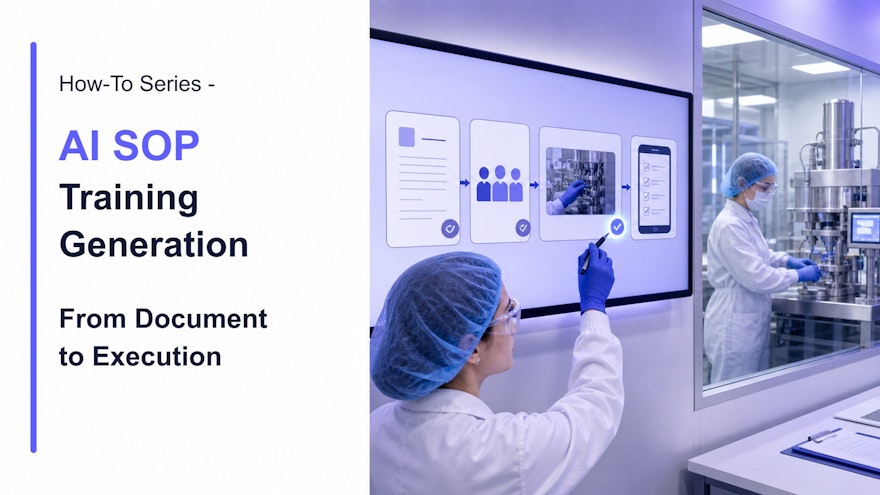
AI SOP training generation can accelerate the transformation between these layers. It can identify sections, draft objectives, propose storyboards, generate narration and build assessment questions. The process fails when automation treats every paragraph as equally important, invents context, or publishes without expert review.
For enterprise-wide authoring governance, see the broader AI training content creation guide covers enterprise-wide authoring governance, while the AI-ready procedures guide covers retrieval and permissions for agents.
Step 1: define the role-based execution package
Do not begin by asking AI to “make a course.” Define what the process requires from each role. A performer, supervisor, approver, maintenance technician and quality reviewer may use the same SOP differently. Map the sections, decisions and evidence relevant to each.
For each role, identify:
- what the person must know before starting;
- what they must recognize or decide;
- what they must physically or digitally perform;
- which errors are critical;
- what they must record, verify or approve;
- when they must stop and escalate;
- what support they may access during work.
Then choose assets by moment of need rather than fashion.
| Execution need | Best-fit asset | Evidence or control |
|---|---|---|
| Understand purpose and process | Short role-based overview | Scenario or knowledge check |
| See a physical sequence | Video work instruction | Approved demonstration and observed practice |
| Choose between conditions | Branching scenario or visual comparison | Decision feedback and pass criteria |
| Perform a system workflow | Annotated screencast and sandbox task | System exercise |
| Recall steps during work | Digital job aid or visual checklist | Current source-version link |
| Prove readiness | Assessment plus supervised qualification | Role-appropriate record and approval |
| Respond to an exception | Escalation flow | Stop/refuse behavior tested |
One SOP may produce several small assets rather than one long course. Conversely, a cross-functional task may require content from multiple controlled sources. Preserve those source relationships.
Step 2: prepare the controlled SOP
AI quality cannot repair an uncontrolled process. Confirm the document owner, approval status, effective version, scope, applicable sites, roles and related records. Resolve conflicting instructions and undocumented workarounds before generation.
Mark the elements the output must preserve:
- prerequisites and authorization;
- sequence and dependencies;
- critical parameters, limits and units;
- warnings, prohibitions and protective controls;
- decision rules and acceptable variation;
- exceptions, deviations and escalation;
- required records and signatures;
- references to equipment, systems and forms.
Separate mandatory instructions from explanation. Expand acronyms and control terminology. Identify diagrams, tables or images that require interpretation. If the source contains confidential, personal or restricted data, define what the AI service and authors are permitted to process.
In pharmaceutical environments, training must relate to assigned functions. 21 CFR 211.25 requires personnel to have the education, training and experience needed to perform assigned functions, including training in the particular operations they perform and continuing CGMP training applicable to those functions. The European Commission’s EudraLex Volume 4 provides the EU GMP framework, including Chapter 2 on personnel and Chapter 4 on documentation.
Step 3: extract executable knowledge
Use AI to propose a structured extraction, not a free-form summary. For every relevant procedure section, capture the actor, action, object, condition, expected result, record and exception. Require source citations to the section or step so reviewers can verify the draft efficiently.
Generate a role map and learning objectives. A good objective describes an observable outcome: “select the correct hold status for three deviation scenarios” is testable; “understand holds” is not.
Ask the AI to identify uncertainty rather than fill it. Missing acceptance criteria, undefined roles and conflicting units should appear in a review queue. The model should never invent a limit, warning, approval or compliance claim.
Step 4: generate the training and execution assets
Create each asset against an approved brief. A video work instruction needs the exact task, audience, environment, duration, shots, critical cues, narration and exceptions. A digital job aid needs the point of use, device, allowed level of detail and link to authority. An assessment needs the objective, evidence type and critical-failure rules.
Role-based training
Generate a concise explanation of why the task matters, how it connects to the process and which decisions the role owns. Use scenarios drawn from approved normal and abnormal conditions. Avoid repeating sections the role does not need.
Video work instructions
Build a storyboard around observable action. Show the approved setup, operator perspective, tools, sequence, key points and expected result. Add close-ups where visual discrimination matters. Do not generate or alter technical imagery in ways that misrepresent equipment, PPE, controls or product state.
Assessments
Generate questions only after objectives are approved. Use plausible alternatives based on real errors. Explain feedback without exposing restricted answers inappropriately. Knowledge questions do not replace observed performance for physical or safety-critical tasks.
Digital job aids
Extract the minimum useful guidance for execution: prerequisite, critical steps, decision rule, warning and escalation. A job aid is not a compressed copy of every SOP paragraph. It remains a governed derivative and does not authorize an unqualified person.
Speach’s AI training generation capabilities help enterprises turn source documents into structured learning, narration, visuals and assessments. Its creation workflow supports video work instructions and interactive formats for frontline and regulated teams.
Step 5: apply expert and GxP review
Qualified human reviewers remain accountable for technical accuracy and release. Use a traceable checklist comparing every output with the approved source.
| Review dimension | Questions |
|---|---|
| Source fidelity | Are steps, sequence, limits and records accurate? |
| Role relevance | Does the asset match assigned responsibility and authority? |
| Risk controls | Are warnings, prohibitions, exceptions and escalation preserved? |
| Visual accuracy | Do equipment, state, PPE and actions reflect approved practice? |
| Assessment validity | Does evidence match the objective and consequence of error? |
| Language quality | Are terminology, units, captions and translations controlled? |
| Data and security | Is sensitive information protected and access appropriate? |
| Traceability | Can reviewers identify the source, version and approvals? |
Test the draft with representative users. Ask them to explain decisions and perform the task under appropriate conditions. If the content is clear only to the subject-matter expert who approved it, it is not ready for the intended audience.
For safety-related instruction, OSHA’s training policy emphasizes presenting information in a language and vocabulary workers can understand and looking beyond paper records to whether people could apply the training. Apply that comprehension principle across operational content.
Step 6: publish training and digital job aids
Release content through the required approval workflow. Record the source version, asset version, audience, reviewers, effective date and status. Assign only the roles affected; blanket assignment adds noise and weakens relevance.
Choose delivery by moment:
- LMS or learning platform for required pathways and records;
- mobile or desktop access for preparation and refreshers;
- QR codes or embedded links for point-of-work guidance where permitted;
- SCORM or xAPI packages where enterprise architecture requires them;
- offline delivery with explicit synchronization and version controls.
Keep training and execution support connected. A worker who fails an assessment should receive targeted learning. A recurring job-aid search may reveal a difficult step. A procedure change should trigger impact assessment across training, videos, questions, translations and job aids.
Define fallback behavior when content is unavailable or the real situation differs from the asset. Employees need a clear stop and escalation route, not encouragement to improvise.
Step 7: measure execution and maintain alignment
Measure the full knowledge-execution chain. Creation speed is useful, but it is not the outcome.
- Production: review time, rework and source-to-release cycle time;
- Learning: completion, scenario performance and confidence calibration;
- Readiness: time to qualification and observed critical errors;
- Execution: first-time quality, support demand and correct escalation;
- Quality: documentation errors, deviations and recurring investigation themes;
- Maintenance: update latency and obsolete-content exposure.
Do not attribute every operational change to training. Equipment, staffing, materials, interfaces and process design may contribute. Combine analytics with supervisor observations, audits and employee feedback.
When the SOP changes, automatically identify affected assets but require the appropriate review before release. Some changes alter only a reference; others invalidate a demonstration, question or qualification. Preserve historical relationships for audit and investigation while preventing obsolete content from guiding current work.
The strategic opportunity is larger than faster course creation. One controlled procedure can become a coordinated execution layer: role-based pharma training, GxP learning evidence, video work instructions, digital job aids and frontline enablement. AI provides leverage; governance keeps every asset connected to the work it is meant to improve.
Frequently asked questions
Can AI generate training from an SOP?
Yes. AI can accelerate extraction, role mapping, storyboards, narration, visuals, questions and job-aid drafts. Qualified reviewers must verify outputs before release.
Should one SOP become one training course?
Not necessarily. Different performers, supervisors and approvers may need different learning and support assets. Follow the role and task, not the document page count.
Does an AI-generated video replace the SOP?
No. The approved SOP remains authoritative. Videos and digital job aids are governed derivatives linked to its source version and intended use.
How do you validate AI-generated SOP training?
Review source fidelity, role relevance, controls, exceptions, records, translations and assessment feedback. Test with users and use the required approval workflow.
How do you measure SOP execution after training?
Combine learning data with observed performance, time to competence, documentation quality, errors, deviations, support demand and change performance.
Turn every SOP into an execution package
Speach transforms controlled procedures into role-based learning, AI-generated videos, assessments and digital job aids—with multilingual delivery, approvals, version control, audit trails and enterprise integrations. Request a demo to connect SOP knowledge to frontline execution.