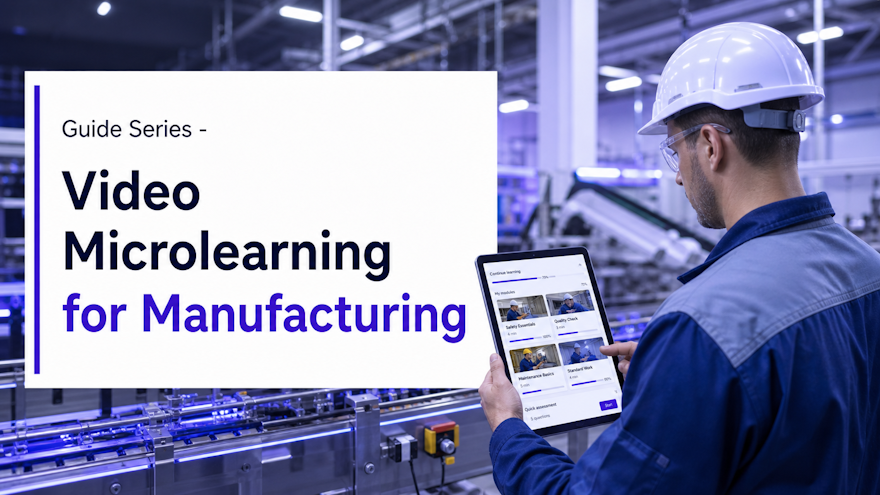
Guide Series
Where short visual learning fits on the factory floor—and how to connect each use case to a real performance outcome.
Originally published January 2, 2024 · Updated July 28, 2026

Why manufacturing needs task-focused learning
Manufacturers must develop skills while production continues. New technologies, product variants, workforce turnover and changing standards create learning needs that cannot always wait for a scheduled class. NIST’s 2026 analysis of the Manufacturing USA Occupation and Competency Framework identifies 132 occupations connected to 235 knowledge, skill and ability requirements across areas including biomanufacturing, automation, electronics and advanced materials. The World Economic Forum’s Future of Jobs Report 2025 also anticipates broad skill disruption.
Video microlearning makes motion and context visible. An operator can see the correct sequence, a technician can inspect a component close-up and a new hire can review a task before coached practice. Short modules are easier to search and update than a long course, but “short” is not the objective. The objective is correct performance. Critical warnings, exceptions and decision criteria must remain intact.
Microlearning should complement structured job instruction. NIST’s Training Within Industry resources describe a consistent method for preparing workers, presenting work, trying out performance and following up. Video can strengthen preparation and reinforcement, while qualified people verify hands-on capability.
Ten video microlearning use cases for manufacturing
1. Safety procedures and hazard recognition
Show the actual hazard, required control, PPE, safe boundary and escalation route in the real work context. Use scenarios to ask employees what they should do when conditions change. Video does not replace site-specific instruction or authorized practical training. OSHA’s safety management guidance emphasizes leadership and worker participation; involve frontline employees in identifying realistic hazards and reviewing content.
2. Standard work and digital work instructions
Demonstrate the approved sequence, critical points and expected result. Add arrows, labels and close-ups where precision matters. Link the module to the controlled procedure and make it accessible at the workstation through the Speach mobile app. When the standard changes, update or retire affected videos under the same change-control process.
3. New-hire onboarding and job qualification
Create a role-based path covering site orientation, safety, quality basics, equipment and common decisions. Use video before hands-on practice so instructor time focuses on observation and coaching. Record the required assessment or sign-off according to the qualification process. Measure time to independent, correct performance—not only course completion.
4. Equipment operation and changeovers
Break a changeover into setup, verification, start-up and abnormal-condition modules. First-person footage can show hand position and sequence; chapter markers make a step easy to retrieve. Include lockout or authorization boundaries without implying that a video alone qualifies someone for hazardous work. Measure changeover time, errors, scrap and start-up stability.
5. Preventive maintenance and troubleshooting
Capture expert inspection routines, normal-versus-abnormal examples and escalation criteria. A troubleshooting asset should help a technician gather evidence and follow an approved decision path, not encourage unauthorized repairs. Link tools, parts, permits and documentation. Track repeat failures, mean time to repair, downtime and support requests.
6. Quality checks and defect recognition
Use clear visual examples of acceptable and unacceptable conditions, measurement technique, sampling points and reaction plans. Avoid relying on screen color if lighting or devices vary. Include calibrated references and current specifications. Short scenario questions can test whether employees recognize a defect and choose the correct containment action.
7. Compliance and documentation practices
Explain the behavior behind the rule: what must be recorded, when, by whom and how errors are corrected. Use realistic examples instead of abstract policy recitation. For regulated operations, Speach’s security and compliance capabilities support permissions, version control, audit trails and electronic signatures. Accountable reviewers should approve content before assignment.
8. Continuous improvement and lean problem solving
Provide one-point lessons on problem statements, gemba observation, 5 Whys, cause-and-effect thinking, PDCA and standardization. Capture a verified improvement and show what changed, why and under which conditions it applies. Explore the full lean manufacturing problem-solving workflow. Measure recurrence and adoption rather than the number of ideas published.
9. Product, process and software changes
When a process changes, publish a focused module identifying affected roles, the effective date, the previous versus new action and where to find the controlled source. Use screen capture for MES or quality-system workflows. Assign only to impacted roles and verify critical understanding. Monitor change-related errors and questions during rollout.
10. Subject-matter expert knowledge capture
Record experienced employees performing difficult or infrequent tasks and explaining the cues they use. AI can help transcribe, structure and translate the draft through Speach’s AI training generator. SMEs must distinguish approved method from personal workaround, and the organization must review the result before it becomes guidance.
How to choose the right first microlearning use case
Start where the performance gap is visible and measurable. Strong candidates have frequent questions, recurring errors, long time to proficiency, costly expert dependence or an imminent process change. Confirm that training can influence the outcome. If defects come from worn tooling or poor material, a better video will not solve the root cause.
| Selection question | Evidence to collect |
|---|---|
| Is the problem important? | Safety risk, defects, downtime, rework, delay or audit exposure |
| Is knowledge a contributing cause? | Observation, interviews, error patterns and task analysis |
| Can video clarify the task? | Motion, sequence, visual criteria or software workflow |
| Is the source controlled? | Approved SOP, standard work, specification or accountable SME |
| Can employees access it? | Device, connectivity, language, permissions and point of use |
| Can the outcome be measured? | Baseline and agreed operational indicator |
Manufacturing microlearning design and governance checklist
- One outcome: define the role, task, conditions and success standard.
- Approved source: identify the procedure, specification or accountable expert.
- Visual fit: show only what improves understanding of motion, sequence or criteria.
- Practice: include realistic decisions and supervised performance where required.
- Accessibility: provide reviewed captions, readable contrast and multilingual review.
- Safety: include boundaries, warnings and escalation without implying authorization.
- Governance: assign owner, version, approval, effective date and review trigger.
- Delivery: use task-based titles, role assignment, mobile access and searchable metadata.
- Measurement: record a baseline and follow-up learning and operational metrics.
How to measure impact and ROI
Do not attach an invented savings percentage to every use case. Establish the baseline, identify other changes and measure after an appropriate period. Learning measures include completion, assessment accuracy, attempts and observed task performance. Operational measures include time to proficiency, first-pass yield, defects, rework, downtime, changeover time, safety observations, support requests and audit findings.
A simple value model compares avoided cost or productive capacity with content creation, review, translation, platform and learner time. Report assumptions and confidence. Segment results by role, site, shift, language and version. If performance improves only in one area, investigate differences in equipment, coaching, access or local process before scaling.
Run the first deployment as a controlled pilot. Select a representative line or shift, publish the approved module, prepare supervisors to coach the new behavior and define the review date in advance. Collect learner questions and observe the task directly. This creates stronger evidence than a satisfaction survey and exposes content, access or workflow issues before enterprise rollout.
After the pilot, decide whether to scale, revise or stop. Document what conditions made the result possible so another site does not copy the asset without checking local equipment, standards, language and qualification requirements.
Frequently asked questions
What is video microlearning for manufacturing?
It is short, task-focused visual instruction designed to help employees learn, recall or correctly perform a specific factory activity, decision or standard close to the moment of work.
How long should a manufacturing microlearning video be?
It should be the shortest duration that achieves one observable objective without removing safety, quality or procedural context. Complex work should be divided into connected, searchable modules rather than forced into an arbitrary time limit.
Can microlearning replace hands-on manufacturing training?
Usually not. Video can demonstrate, prepare and reinforce, but tasks requiring supervised practice, qualification or physical skill still need appropriate hands-on instruction and performance verification.
How do manufacturers keep microlearning current?
Connect each module to its approved source, owner, version, effective date and review trigger. When equipment, software, standards or procedures change, assess and update all affected learning assets.
How should manufacturing microlearning ROI be measured?
Compare production and learning baselines with outcomes such as time to proficiency, first-pass yield, defects, rework, downtime, changeover time, safety observations, support requests and audit findings. Avoid attributing every change to training alone.
Bring visual knowledge into the flow of factory work
Speach helps manufacturing teams transform procedures and expert know-how into role-based video microlearning, assessments and governed work instructions. Request a demo to prioritize your highest-value use cases.