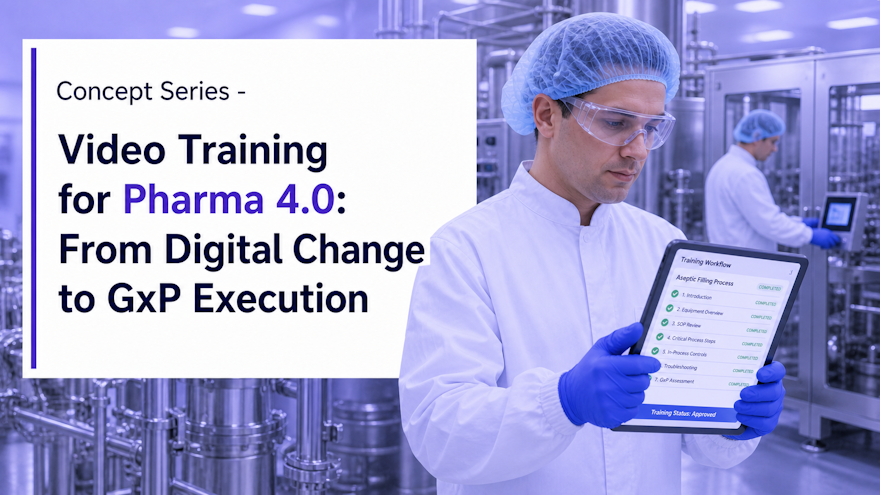
Concept Series
Pharma 4.0 is not achieved by connecting equipment and data alone. Digital transformation changes how people monitor processes, interpret information, make decisions and document work. Governed video training can help translate those changes into role-based competence and consistent execution across pharmaceutical manufacturing sites.
What is Pharma 4.0?
Pharma 4.0 applies Industry 4.0 capabilities—including connected systems, automation, advanced analytics and AI—to the pharmaceutical product lifecycle. The aim is not technology for its own sake. It is more transparent, adaptive and reliable manufacturing that protects product quality, compliance and patient supply.
ISPE describes Pharma 4.0 as an evolution in which digitalization and automation meet complex pharmaceutical products, processes and regulatory expectations. Its operating model includes more than information systems: organization and processes, resources, culture, data integrity and a qualified workforce are part of the transformation.
This distinction matters for training. A connected line may deliver more real-time information, but an operator still needs to understand the process, recognize abnormal conditions and respond within an approved scope. A new analytics tool may highlight a trend, but Quality and production teams need shared rules for interpreting, escalating and documenting it.
Why the workforce is a critical Pharma 4.0 enabler
Digital systems change the distribution of work between people and technology. Routine actions may be automated while employees take on more exception handling, investigation, verification and cross-functional decision-making. That requires technical skills, process knowledge and confidence in when not to proceed.
ISPE’s seventh Pharma 4.0 survey reported a shift from planning toward live pilots and systematic ongoing action: the combined “pilots” and “systematic ongoing actions” groups represented 58.1% of respondents in the maturity analysis. As programs move beyond isolated pilots, repeatable training and governance become more important.
The FDA’s Quality Management Maturity program emphasizes quality culture, continual improvement and integration of manufacturing operations, quality practices and technology. Training should therefore support the quality system and business performance together—not sit downstream as a completion exercise.
The role of video training in Pharma 4.0
Video is useful when employees must see a physical sequence, interface state, visual quality criterion or expert decision. It can show correct interaction with new equipment, explain the logic behind a digital workflow and capture the tacit cues experienced employees use. Short modules are also easier to update when a process or system changes.
Video alone does not establish competence. A strong learning experience may combine an approved visual demonstration with the governing SOP, a scenario-based assessment, supervised practice, observed qualification and a point-of-work job aid. The required mix depends on the task, risk and applicable procedure.
The value comes from connection. Training should be linked to the source procedure, assigned by role, available in the employee’s language and governed through its lifecycle. Speach’s SOP-to-training workflow helps turn controlled content into visual, role-based learning rather than producing an isolated video library.
Seven high-value video-training use cases
1. New equipment and automation
Show the approved startup, shutdown, checks and response to common system states. Capture the screen and physical environment where permitted, and distinguish what the system performs automatically from what the operator must verify. Link the training to hands-on practice before qualification.
2. Electronic batch and workflow systems
Use screen demonstrations to explain role-specific actions, data-entry expectations, review steps and escalation paths. Avoid production data in the recording. When the interface changes, update only the affected modules and preserve the prior training history.
3. Aseptic and cleanroom practices
Video can make sequence, hand placement and contamination-control behavior visible. Filming must itself respect site procedures. Use a controlled simulation if production-area recording creates a risk, and require practical observation where the procedure calls for it.
4. Data integrity and good documentation practices
Scenario-based video can show the difference between compliant and noncompliant actions without reducing the topic to a list of rules. Ask learners to decide what to record, correct or escalate. Tie examples to the organization’s approved procedures and systems.
5. Deviation and CAPA workflows
Different roles need different decisions. Operators may need to preserve evidence and notify a supervisor; investigators need deeper instruction on analysis and documentation. Role-based modules reduce irrelevant detail and clarify ownership at each stage.
6. Technology transfer and site standardization
Visual demonstrations help teams compare how a process is executed across locations. SMEs can reveal assumptions that a written transfer package may not capture. Any local difference should be evaluated and approved rather than silently embedded in separate videos.
7. Point-of-work refreshers
A qualified employee may need a short reminder for an infrequent step. Provide concise, searchable job aids through an approved device while keeping initial qualification separate. Speach’s mobile app can bring current guidance closer to the work.
GxP, data integrity and training governance
Every training asset should have an owner, source-document reference, version, approval status, effective date and review date. Define which roles may create, approve, publish and retire content. Employees should access only the effective version, while authorized teams retain the audit history.
When a procedure, system or process changes, assess the effect on training, assessments, translations and job aids. The change-control workflow should identify dependencies automatically where possible. For regulated records and signatures, determine the applicable predicate rules and whether 21 CFR Part 11 applies.
FDA’s Part 11 guidance describes controls including authorized access, operational and authority checks, appropriate system documentation and education, training and experience for people who develop, maintain or use electronic systems. It also recommends a justified, documented risk assessment for computerized systems.
Video does not automatically make training compliant. Compliance depends on the full system: accurate content, qualified reviewers, appropriate assignment, evidence, records, effectiveness evaluation and ongoing control. Speach’s security and compliance capabilities support audit trails, electronic signatures, access controls and governed publication.
How to implement Pharma 4.0 video training
Start with a transformation milestone
Choose one defined change such as a new electronic workflow, equipment upgrade or recurring data-integrity gap. Establish the affected roles, risks, current performance and desired behavior. Avoid beginning with a broad mandate to “convert all training to video.”
Build a cross-functional team
Include Operations, Quality, L&D, the system or process owner, IT or automation, validation and representative employees. Decide who supplies the controlled source, who demonstrates the work and who approves the final asset. Early alignment shortens review cycles.
Create modular, role-based content
Separate foundational concepts from task-specific steps. Keep each video focused and searchable. Add accurate captions, transcripts and reviewed translations. Speach’s AI Training Generator helps convert procedures into visual training, assessments and job aids, while role-based training limits assignments to what each group needs.
Validate with the learner and the process
Test the draft with a representative employee in a controlled environment. Ask the learner to make a decision or demonstrate the task, not only replay information. Complete the required technical, Quality and validation reviews before effective publication.
Connect learning to execution
Make approved refreshers available through the systems and devices employees use, subject to site rules. Link the training to the current procedure and qualification record. Provide a clear route for questions, feedback and escalation.
How to measure the impact
Measure reach and learning, but do not stop at completion. Track assessment performance, observed proficiency, time to qualification and confidence with the new process. Connect those measures to operational and quality indicators such as first-time-right rate, documentation errors, repeat deviations, support requests, review-cycle time and downtime.
FDA describes quality metrics as an objective way to monitor products and processes and drive continual improvement in manufacturing. Review training evidence alongside process and quality signals. A faster course rollout is not successful if errors rise, and a high completion rate does not prove that employees can act correctly.
Segment results by role, shift, site and language. Search queries with no useful result reveal knowledge gaps; repeated rewinds may expose a difficult step; low adoption may indicate poor access or weak supervisor support. Use these signals in scheduled content reviews.
A practical Pharma 4.0 training pilot
- Define: select one digital change, affected roles, controlled sources and success measures.
- Design: map the role-based learning, practical qualification and point-of-work support.
- Create: record SMEs, build modular content, assessments, captions and translations.
- Review: complete technical, Quality, accessibility and validation activities appropriate to risk.
- Deploy: assign the training, supervise practice and publish approved job aids.
- Improve: compare learning and process results with the baseline before scaling.
Pharma 4.0 succeeds when digital capabilities become reliable ways of working. Governed video training helps close the gap between installing technology and building the human competence needed to use it within a mature quality system.
Speach supports life-sciences organizations with AI-assisted content creation, multilingual delivery, audit trails, electronic signatures, version control and enterprise integrations. Explore the life-sciences platform or request a demo.