Why read-and-sign is not the same as competence
A controlled SOP defines an approved way of working, but access to the document does not prove that an employee can interpret and perform it. Dense language, unfamiliar context and role ambiguity can separate document acknowledgement from correct execution. For a low-risk policy update, acknowledgement may be appropriate. For aseptic technique, equipment setup, data correction or hazardous work, employees may need demonstration, coached practice and qualification.
U.S. drug CGMP requirements in 21 CFR 211.25 state that personnel must have the education, training and experience—or a combination—needed to perform assigned functions, and that CGMP training be conducted by qualified individuals on a continuing basis with sufficient frequency. The precise training approach still depends on the role, procedure, risk and quality system.
This is why SOP training should begin with competence, not the delivery format. Ask: What must the learner know? What must they do? Which decisions or exceptions are critical? How will the organization verify and sustain the behavior? The answers determine whether to use a visual explanation, scenario, hands-on demonstration, checklist, supervised practice or a blend.
Eight best practices for effective SOP training
1. Start from the current approved procedure
Record the SOP identifier, version, effective date, owner and applicable roles before creating training. Resolve contradictions and avoid teaching from an unofficial copy. Link every video, assessment, translation and job aid to its source. When the SOP changes, the relationship should identify all affected learning assets.
2. Conduct a role and risk analysis
Separate performers, verifiers, approvers, supervisors and supporting roles. Identify critical steps, warnings, decisions, prerequisites and escalation points. Apply more rigorous training and assessment where an error could affect patient safety, product quality, employee safety, data integrity or compliance. Speach supports role-based training so employees receive only the relevant context without losing essential controls.
3. Translate the SOP into observable objectives
“Understand SOP-123” is not measurable. “Select the correct status, record the reason for change and preserve the original entry” describes behavior. Objectives should state the action, conditions and standard. They guide the script, practice and evaluation and help prevent a long module that merely paraphrases every paragraph.
4. Use visuals to reveal motion, sequence and context
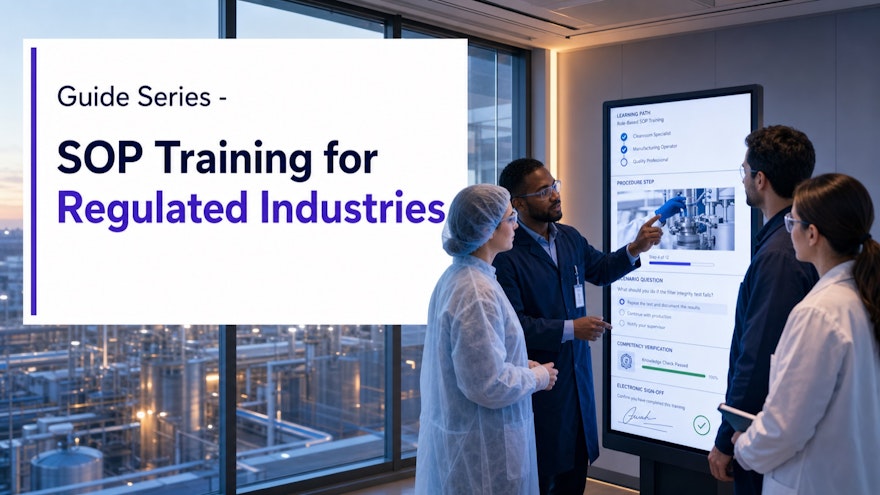
Video can show a cleanroom behavior, inspection point, system action or equipment sequence that prose cannot make visible. Use arrows, close-ups and freeze frames for critical details. Do not stage an unsafe demonstration or simplify away an exception. Speach’s AI training generator can draft visual workflows from an SOP, while accountable SMEs verify every instruction.
5. Build decisions and practice into the learning
Pause before a critical step and ask what should happen next. Present a realistic deviation, failed check or documentation error and require the correct response. Feedback should explain the rationale and consequence. Physical or complex skills may require supervised practice with a qualified trainer; a quiz alone is not enough.
6. Make training accessible and multilingual
Provide accurate captions, transcripts, readable contrast and appropriate device access. Translate from a validated master with an approved glossary and target-language review. Employees must understand the vocabulary used for their work. Separate language availability from authorization: a translated resource still requires the appropriate approval and effective-version control.
7. Apply documented review and approval
Define who reviews technical accuracy, instructional design, quality requirements, language and legal or privacy issues. Capture comments and resolution. Speach’s security and compliance capabilities support permissions, version control, audit trails and electronic signatures. The organization remains responsible for its intended use, validation and procedures.
8. Reinforce and requalify based on change and performance
Train affected employees before they perform work under a new or revised SOP. Use change summaries to show what changed and why, then assess only what is relevant. Continuing reinforcement can respond to deviations, audit observations, new equipment, infrequent tasks or declining performance. Avoid annual retraining as a substitute for investigating a poorly designed process or instruction.
Choose the right SOP training and assessment method
| Need | Training method | Evidence |
|---|---|---|
| Awareness of a low-risk change | Concise summary plus SOP access | Acknowledgement or targeted check |
| Concept or policy understanding | Visual explanation and scenario | Knowledge or decision assessment |
| Software procedure | Screen demonstration and sandbox practice | Successful workflow completion |
| Physical task | Video demonstration and coached practice | Observed performance checklist |
| High-risk or regulated skill | Blended instruction and qualified supervision | Documented qualification per procedure |
| Infrequent critical response | Scenario, simulation and job aid | Correct action under simulated conditions |
No single method fits every SOP. Use the least burdensome method that provides sufficient confidence for the risk. A strong program may combine a short video microlearning module, the controlled SOP, a job aid and supervisor observation.
Training records, governance and change control
Training evidence should make it possible to determine who completed which requirement, for which role, against which content version, when, with what result and under whose approval or qualification. Record corrections according to approved procedures. FDA guidance on data integrity and CGMP compliance emphasizes reliable and accurate data; the training system should not create ambiguous or easily overwritten records.
Create a dependency map between SOPs, curricula, learning assets, assessments and roles. A change to a source should trigger impact assessment rather than relying on someone to remember every derivative. Retire superseded materials, update assignments and preserve history according to retention requirements. Speach’s SOP training software connects source content to visual training, workflows, assessments and job aids.
Control access by role and site, especially for confidential processes. Test integrations, electronic signatures, timestamps, exports and reports in the intended environment. Mobile access through the Speach app can support point-of-work learning where permitted, but it should not bypass qualification or procedural controls.
How to evaluate SOP training effectiveness
CDC guidance on measuring training effectiveness recommends evaluating both learning and transfer to the workplace. Use pre/post comparison where appropriate, but also select the assessment that matches the objective: a question for knowledge, a scenario for judgment, a demonstration for skill and workplace observation for transfer.
Track assignment, completion, assessment accuracy, attempts and qualification status, then connect these data to deviations, errors, rework, audit observations, support questions, first-time-right execution and time to proficiency. Segment by role, site, language and version. If employees pass a quiz but continue to make the same error, investigate whether the assessment, procedure, interface, equipment or supervision—not simply the learner—is the problem.
Evaluate the training system itself: time from SOP approval to effective training, overdue assignments, affected assets updated on time, reviewer effort and recurring content corrections. The goal is timely, defensible competence—not a growing count of completed courses.
Set the evaluation plan before launch. Name the baseline period, responsible analyst, data sources, follow-up interval and threshold for action. Protect employee privacy and avoid using an isolated training score as a substitute for a complete performance assessment. Where several changes occur together—new equipment, staffing, process design and training—report the combined context instead of attributing the full result to the learning module.
Use findings to improve the SOP as well as the course. Repeated questions may reveal unclear wording; repeated errors at one step may indicate weak visual design or an impractical method. Closing this loop turns training data into evidence for quality and operational improvement.
Frequently asked questions
What is SOP training?
It is a structured process that helps employees understand and correctly apply the current procedure for their assigned role, then provides appropriate evidence of learning, practice, qualification or acknowledgement.
Is reading and signing an SOP enough?
A signature can document acknowledgement, but it does not by itself demonstrate understanding or competent performance. The required method should follow the task risk, role and applicable quality-system requirements.
How often should employees receive SOP training?
Training should occur before employees perform affected work and when relevant procedures, responsibilities or systems change. Continuing or refresher training should follow applicable regulations, risk, performance signals and the organization’s program.
How do you assess SOP training effectiveness?
Use knowledge checks for concepts and observed demonstrations or simulations for skills, then monitor workplace transfer through correct execution, deviations, errors, rework, audit findings and supervisor observation.
Can AI generate SOP training?
AI can draft role-based scripts, visual workflows, questions, captions and translations from approved sources. Qualified humans must verify accuracy, context and compliance before approval and release.
Move from SOP acknowledgement to verified execution
Speach helps regulated teams transform controlled procedures into visual, role-based, multilingual training with assessments, approvals and audit-ready evidence. Request a demo to modernize your SOP training program.